
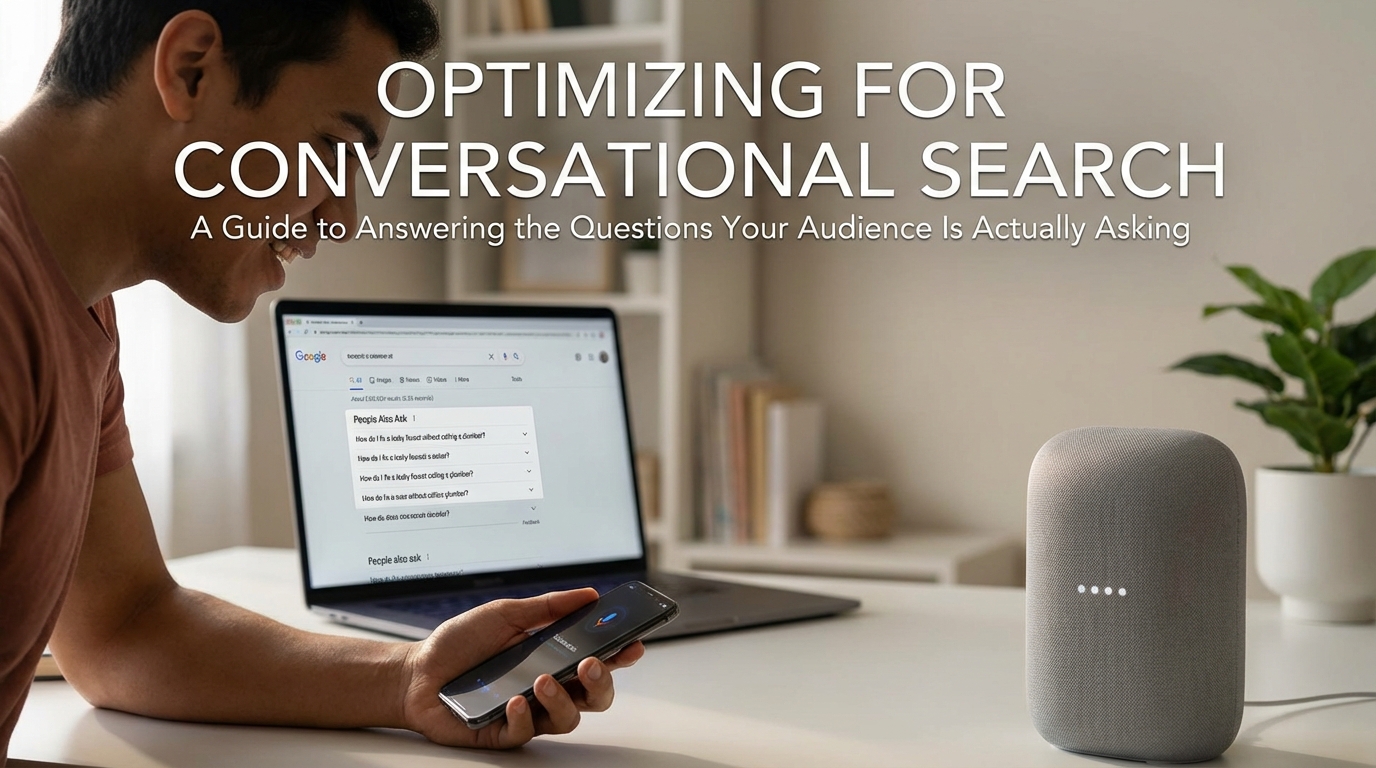
"Hey Google, how do I fix a leaky faucet without calling a plumber?" "Alexa, what are the best dog breeds for a family with small children?" "Siri, where can I find a good Italian restaurant near me that's open now?" This is the new face of search. Gone are the days of typing two or three stilted keywords into a search bar. Today, we talk to our devices. We ask them full, complex questions, just as we would a human expert. This fundamental shift from keyword-based queries to natural language questions is the core of conversational search. Fueled by the rise of voice assistants, the dominance of mobile devices, and incredible advancements in artificial intelligence, search engines are no longer just matching words; they are understanding intent. For businesses, content creators, and marketers, this isn't just a trend—it's a seismic shift in how we need to approach SEO. Simply targeting a high-volume keyword like "leaky faucet" is no longer enough. To succeed in this new landscape, you must anticipate and directly answer the detailed, long-tail questions your audience is asking. This article will serve as your comprehensive guide to mastering conversational search, showing you how to find the exact questions your users are asking and how to build content that provides the perfect answer.
What is Conversational Search and Why Does It Matter?
At its heart, conversational search is the practice of users interacting with search engines using natural, everyday language. Think of it as a dialogue. Instead of a user inputting "running shoes best," they now ask, "what are the best running shoes for someone with flat feet?" The second query is longer, more specific, and reveals a much clearer user intent. This evolution is driven by several key technological and behavioral changes.
First and foremost is the explosion of voice search. Smart speakers like Amazon Echo and Google Nest are in millions of homes, and virtual assistants are built into every smartphone. Speaking a query is often faster and more convenient than typing, especially when on the go. This verbal interaction naturally lends itself to full sentences and questions.
Second, search engines themselves have become incredibly sophisticated. Google's algorithm updates, such as BERT and the more recent MUM (Multitask Unified Model), have drastically improved its ability to understand the context and nuances of human language. These AI-driven systems can now decipher the intent behind complex queries, moving beyond simple keyword matching to a deeper comprehension of what the user is truly looking for.
So, why is this so critical for your SEO strategy?
- High User Intent: A long-tail question reveals a lot about where the user is in their journey. Someone searching for "SEO" is likely in the early research phase. Someone asking "how much does it cost to hire an SEO agency for a small business?" is much closer to making a purchasing decision. Answering their specific question positions you as the expert at a critical moment.
- Reduced Competition: While the head term "running shoes" is incredibly competitive, the long-tail question "what are the best trail running shoes for rocky terrain?" has a much smaller, more targeted pool of competition. This allows smaller businesses and niche sites to rank for highly relevant terms.
- Featured Snippet and Voice Search Opportunities: Search engines often pull answers for voice search and "Position Zero" featured snippets directly from content that provides a clear, concise answer to a user's question. Optimizing for conversational search is, by extension, optimizing for these highly visible and valuable SERP features.
Ignoring conversational search is no longer an option. It's about meeting your users where they are and speaking their language. By understanding the intent behind their questions, you can create content that is not just optimized for search engines, but genuinely helpful for your audience.
From Keywords to Questions: The Power of the Long-Tail
To effectively optimize for conversational search, you first need to understand the anatomy of the queries themselves. These are not your traditional "head" or "body" keywords. Conversational queries are almost exclusively long-tail keywords—highly specific search phrases that, while having lower individual search volume, collectively make up the majority of all searches. They are the bread and butter of a modern SEO strategy.
The defining characteristic of these queries is that they are structured as questions. They typically begin with one of the "5 Ws and H": Who, What, When, Where, Why, and How. Each of these question-starters signals a different type of user intent, which can help you tailor your content more effectively.
Let's break them down:
- Who: These queries are typically informational and seek to identify a person, group, or entity. For example, "Who founded the company Patagonia?" or "Who are the main competitors to HubSpot?"
- What: This is a broad category that can be informational ("What is content marketing?"), investigational ("What are the best features of the new iPhone?"), or even transactional ("What is the price of a Telsa Model 3?").
- When: These are time-based informational queries. Examples include "When is the best time of year to plant tomatoes?" or "When does the new season of Stranger Things come out?"
- Where: These queries have strong local intent. "Where can I find a certified public accountant near me?" or "Where is the closest emergency vet?" are classic examples that signal an immediate need in a specific geographic area.
- Why: This is perhaps one of the most valuable question types. "Why" questions signal a user looking for an explanation, a reason, or a solution to a problem. Think "Why are my houseplants' leaves turning yellow?" or "Why is my website's bounce rate so high?" Answering these questions positions you as a trusted troubleshooter and expert.
- How: These are instructional queries from users who want to learn how to do something. "How to build a raised garden bed?" or "How do I create a pivot table in Excel?" Content that answers "how-to" questions, like tutorials, guides, and step-by-step instructions, is incredibly valuable and evergreen.
The clarity of intent is the true power of long-tail questions. A search for "email marketing" is ambiguous. Is the user looking for a definition, a software platform, a job, or a course? It's hard to say. But a search for "how to write a compelling email subject line to increase open rates" tells you everything you need to know. The user has a specific problem, and they are actively looking for a specific solution. Your job is to provide it.
Unlocking User Intent with Google's "People Also Ask"
Now that we understand the 'what' and 'why' of conversational search, let's get to the 'how'. How do you find these valuable long-tail questions your audience is asking? While many sophisticated tools exist, one of the most powerful and accessible resources is built directly into the Google search results page: the "People Also Ask" (PAA) box.
The PA_A box is a dynamic SERP feature that displays questions related to your original query. It's a direct window into the minds of searchers, showing you the logical next steps and related queries that Google's algorithm has identified as relevant. Think of it as Google handing you a roadmap of user curiosity on a silver platter.
Here is a step-by-step process for using PAA to build a comprehensive content strategy:
- Start with a Broad Topic: Begin your research with a broad "head" term related to your niche. For instance, if you sell indoor plants, you might start with a search for "houseplant care."
- Analyze the Initial PAA Box: Look at the first four or five questions that appear in the PAA box. For "houseplant care," you might see questions like "How do you keep houseplants alive for beginners?" or "What is the most common mistake in houseplant care?" These are your foundational, high-level questions.
- Dive Down the Rabbit Hole: This is where the magic happens. Click on one of the questions in the PAA box. Not only will it expand to show a short answer (a featured snippet from another website), but it will also dynamically load several more related questions at the bottom of the list.
- Keep Clicking and Expanding: Continue clicking on the new questions that seem most relevant to your audience. Each click will reveal another branch of user inquiry. A question about "beginners" might lead to questions about "low-light plants," which might lead to questions about "snake plants," which could lead to "how often to water a snake plant." You are effectively mapping out the entire user journey, from broad interest to hyper-specific problems.
- Organize and Prioritize: As you uncover these questions, document them in a spreadsheet or a document. Don't just create a long, unorganized list. Start grouping them into logical categories or themes. You might have clusters of questions around "watering problems," "pest control," "repotting," and "choosing the right plant." This process will not only give you dozens of content ideas but will also help you structure your articles and site architecture.
By systematically mining the PAA box, you move beyond guessing what your audience wants to know. You are using Google's own data to build a content plan based on proven user behavior and search patterns, ensuring that every piece of content you create is designed to answer a real, pressing question.
Expanding Your Research: Tools Beyond the SERP
While the "People Also Ask" box is an incredible starting point, a robust research process should incorporate a variety of sources to get a 360-degree view of your audience's questions. Relying on a single tool can give you a narrow perspective. To truly master conversational search, you need to expand your toolkit and listen to your audience wherever they are having conversations.
Here are some other powerful tools and platforms to find long-tail questions:
- AnswerThePublic: This free tool is a favorite among content marketers for a reason. You enter a seed keyword, and it generates a beautiful visualization of hundreds of questions and prepositions related to your topic, all scraped from Google's autocomplete data. It organizes them into "who, what, when, where, why, how" categories, making it incredibly easy to brainstorm content ideas and see the full spectrum of user queries.
- AlsoAsked: This tool takes the PAA concept and visualizes it. Instead of just a list, AlsoAsked creates a branching diagram that shows the relationships between different PAA questions. This is extremely useful for understanding how different subtopics relate to each other and for planning out comprehensive "hub" articles that cover a topic in its entirety.
- Community Forums like Reddit and Quora: Where do people go when they have a problem they can't solve? They go to communities of like-minded people. Platforms like Reddit and Quora are goldmines of raw, unfiltered user questions. Search for subreddits or Quora topics related to your industry (e.g., r/personalfinance or r/skincareaddiction). Pay close attention to the language people use, the problems they are struggling with, and the solutions the community offers. This provides invaluable qualitative insight into your audience's pain points.
- Your Own Internal Data: Don't overlook the data you already have. Your customer service team, sales representatives, and social media managers are on the front lines, talking to your customers every day. Create a system to log the questions they receive. What are the common points of confusion about your product? What obstacles do potential customers face? These are the most qualified questions you could possibly answer because they come directly from your target audience.
- Paid SEO Tools (Ahrefs, Semrush, etc.): Professional SEO suites like Ahrefs and Semrush have powerful keyword research tools that include a "Questions" report. You can input a keyword, and they will pull a massive list of question-based queries from their database, complete with search volume and difficulty metrics. This is excellent for validating the questions you've found elsewhere and for prioritizing which ones to target first based on a combination of relevance and search demand.
By combining the real-time insights from PAA and community forums with the quantitative data from professional SEO tools, you can build a nearly unassailable content strategy. You'll not only know *what* questions to answer but also *which* ones are most important to your business goals.
Crafting Content That Directly Answers User Questions
Finding the right questions is only half the battle. The next, most critical step is to create content that provides the best, clearest, and most satisfying answer. The structure and format of your content are just as important as the information itself. Search engines are looking for clear signals that your page directly addresses a specific query, and users are looking for quick, scannable answers to their problems.
Here’s a practical framework for building answer-focused content:
- Make Questions Your Headings: This is the most direct way to signal relevance. Take the long-tail questions you discovered during your research and turn them directly into headings (
<h3>and<h4>) within your article. For example, if your research revealed the question "Why are my fiddle leaf fig's leaves getting brown spots?", your heading should be exactly that. When a user lands on your page from that search, they immediately see their exact question, confirming they're in the right place. - Embrace the Inverted Pyramid: Traditional writing often builds up to a conclusion. For the web, do the opposite. Lead with the answer. This is called the inverted pyramid method. In the first paragraph directly below your question-based heading, provide a clear, direct, and concise answer. This is crucial for winning featured snippets, as Google often pulls this initial summary. After providing the direct answer, you can then use the rest of the section to elaborate, provide context, give examples, and add supporting details.
- Create Comprehensive "Hub" Pages: Instead of writing a short 300-word blog post for every single question, group related questions into a single, comprehensive "hub" article. Using your research from the PAA and AlsoAsked tools, you can structure a long-form guide that covers a topic from all angles. For example, an article titled "The Ultimate Guide to Sourdough for Beginners" could be structured with headings that answer:
- What is a sourdough starter?
- How do I feed my sourdough starter?
- Why is my sourdough starter not rising?
- What is the best flour for sourdough bread?
This approach creates a one-stop resource that satisfies multiple user intents, keeps users on your page longer, and establishes your site as an authority on the topic.
- Format for Scannability: Nobody reads a wall of text online. Break up your content to make the answers easy to find and digest. Use bullet points, numbered lists (for step-by-step instructions), bold text to highlight key terms, and short, punchy paragraphs. This not only improves the user experience but also helps search engine crawlers understand the structure and key points of your content.
By following this structure, you create content that serves two masters: the search engine algorithm and the human reader. You provide clear signals to Google about what your content is about while delivering a fantastic, user-friendly experience that solves your audience's problems efficiently.
The Final Polish: Optimizing for Voice and Snippets
The ultimate goal of optimizing for conversational search is often to capture a coveted featured snippet or become the chosen answer for a voice search query. The two are deeply intertwined; voice assistants like Google Assistant and Alexa frequently read the featured snippet aloud as the answer. Therefore, the final step in your process should be to polish your content with these specific formats in mind.
Think of this as the last mile of optimization. You've already done the heavy lifting by finding the right questions and structuring your content to answer them directly. These final touches will significantly increase your chances of being featured.
Here are the key optimization tactics to focus on:
- Write in Natural, Conversational Language: This cannot be overstated. Your content should sound natural when read aloud. Write in a clear, accessible tone. Avoid overly complex sentence structures and industry jargon unless your target audience is highly technical. A good rule of thumb is to read your content out loud. If it sounds robotic or awkward, rewrite it until it flows smoothly. Remember, a machine will be reading this to a person.
- Target the "Answer Snippet" Sweet Spot: Research has shown that the ideal length for a featured snippet answer is between 40 and 60 words. This is about one to three concise sentences. When you're writing the direct answer at the beginning of each section (as per the inverted pyramid method), aim for this length. Provide a complete, self-contained answer within that small paragraph. This gives Google a perfectly sized chunk of text to lift directly into the search results.
- Leverage Schema Markup (Structured Data): Schema markup is a code vocabulary that you add to your website's HTML to help search engines better understand your content. It's like giving Google a cheat sheet. For answer-focused content, two types of schema are particularly valuable:
- FAQ Schema: If you create a page with a list of questions and answers, use FAQ schema to mark up each question and its corresponding answer. This can result in a rich snippet in the SERPs, displaying your questions and answers directly under your search result.
- How-To Schema: For instructional content that answers a "how-to" query, use How-To schema to outline the specific steps. This can make your content eligible for rich results that show a step-by-step guide, complete with images, directly in the search results.
- Prioritize "Near Me" Local Signals: For any content answering "where" or "near me" questions, local SEO fundamentals are paramount. Ensure your Google Business Profile is fully optimized and up-to-date. Your business name, address, and phone number (NAP) must be consistent across your website and all local directories. Embedding a Google Map and including location-specific keywords within your content can also strengthen these signals.
By applying these final layers of optimization, you are not just creating a great blog post; you are creating a structured, machine-readable piece of content primed to perform in the most valuable and visible placements on the search results page.
The landscape of search has irrevocably shifted towards a more human, conversational model. Users no longer think in stilted keywords; they ask questions, seek solutions, and expect direct, high-quality answers. For content creators and SEO professionals, this presents an immense opportunity. By moving our focus from simply matching keywords to truly understanding and addressing user intent, we can create content that is more valuable, more effective, and more aligned with the future of search. The process is clear: it begins with deep listening. It involves using powerful tools like "People Also Ask," AnswerThePublic, and community forums to uncover the precise language and pain points of your audience. From there, it's about a strategic approach to content creation—structuring articles around questions, providing direct answers upfront, and building comprehensive resources that establish true authority. Finally, it's about polishing that content with technical optimizations like Schema markup and conversational language to capture a prime position in voice search and featured snippets. Ultimately, the future of SEO is about empathy. It's about putting yourself in your customer's shoes and dedicating yourself to providing the best, most helpful answer to their question. When you make genuine helpfulness the cornerstone of your strategy, you are not only satisfying the demands of search engine algorithms but, more importantly, you are building trust and loyalty with the people who matter most: your audience.
More Tips For Website Improvement

2026
21Oct
A Complete SEO Audit Checklist in 12 Simple Steps
In the vast, ever-shifting landscape of the internet, simply having a website is no longer enough. To truly succeed, your site needs to be visible to the right audience, and that means earning a top spot on search engine results pages (SERPs). This is where Search…

2026
12Oct
A Guide to Competitor Keyword Analysis and Strategy
In the vast, ever-shifting landscape of search engine optimization, staying ahead of the curve is not just an advantage; it's a necessity. You can have the most well-designed website and the most compelling product, but if your target audience can't find you, your…

2026
09Oct
How to Create an Effective 2026 SEO Report and Template
The world of Search Engine Optimization is in a constant state of flux, and as we navigate deeper into 2026, the way we measure and communicate success has evolved dramatically. Gone are the days of flaunting simple keyword ranking lists or basic traffic graphs.…


