
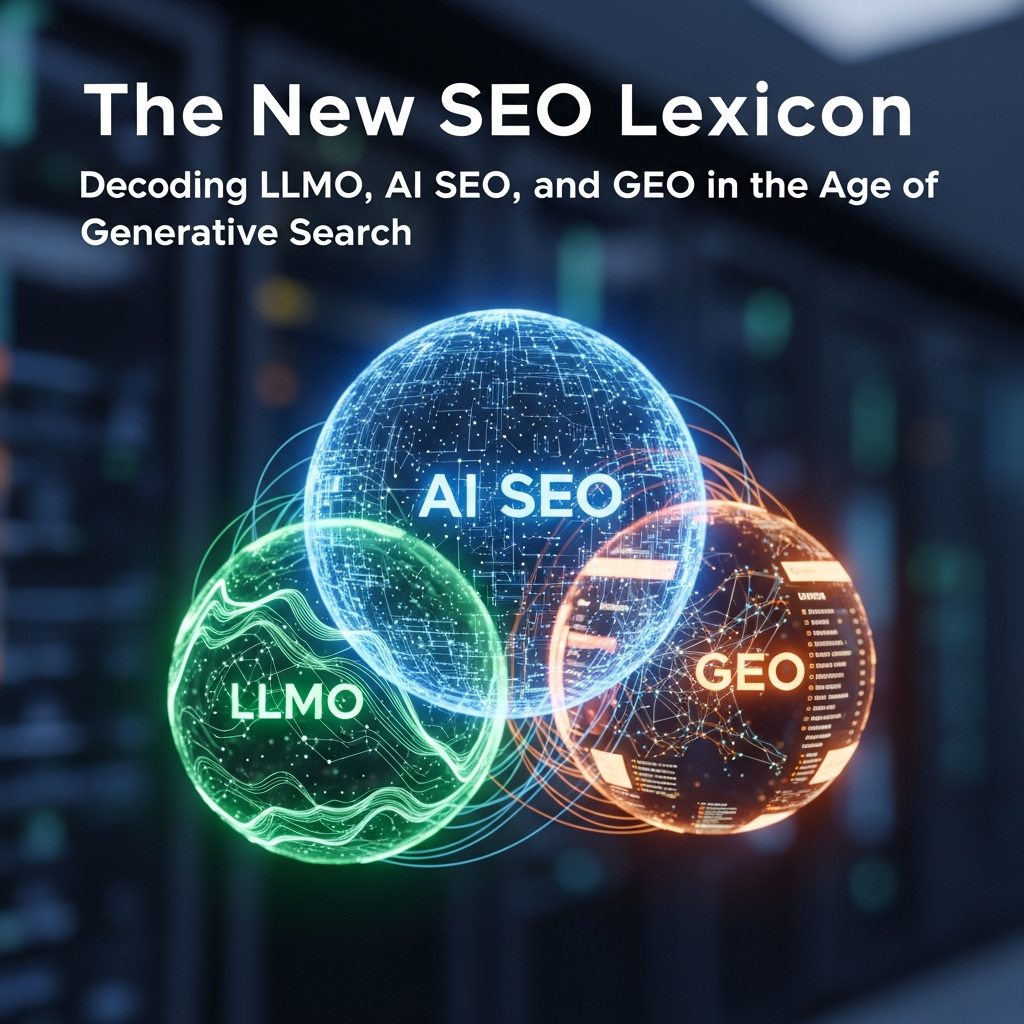
The New SEO Lexicon: Decoding LLMO, AI SEO, and GEO in the Age of Generative Search
The world of search engine optimization is in the midst of a seismic shift, one that is fundamentally reshaping how we create, optimize, and measure digital content. For years, marketers have mastered the art of appealing to algorithms, learning the intricate dance of keywords, backlinks, and technical signals. But the rise of generative AI, spearheaded by innovations like OpenAI's ChatGPT and Google's Search Generative Experience (SGE), has introduced a new player to the game: the Large Language Model (LLM). This evolution isn't just another algorithm update; it's a paradigm shift from a search engine that links to answers to one that synthesizes and generates them directly. As a result, a new vocabulary is emerging, leaving many seasoned professionals scrambling to keep up. Acronyms like AI SEO, LLMO, and GEO are now buzzing in marketing circles, often used interchangeably and incorrectly. Are they all the same thing? Are they competing strategies? This article will serve as your definitive guide, a glossary for the new era of search. We will meticulously define, differentiate, and demystify these critical terms, providing a clear roadmap to help you understand not just what they mean, but how they interconnect to form the future-proof SEO strategy your business needs to thrive in this new AI-powered landscape.
The AI Revolution in Search: A New Paradigm
To truly grasp the significance of terms like GEO and LLMO, we must first appreciate the magnitude of the change happening in search. For over two decades, the dominant model has been the "ten blue links." A user types a query, and the search engine returns a list of ranked web pages it deems most relevant. The entire discipline of SEO was built around influencing this ranking. We focused on creating content that matched keywords, building authority through backlinks, and ensuring our sites were technically sound so crawlers could easily index our pages.
Generative AI obliterates this traditional model. Instead of just providing links, generative engines like Google's SGE and Perplexity aim to provide a direct, conversational, and synthesized answer at the very top of the results page. This "AI Snapshot" or "AI Overview" is generated by a Large Language Model that has processed vast amounts of information from across the web. It doesn't just point to an answer; it creates the answer, often citing the sources it used to formulate its response. This fundamental change poses an existential question for digital marketers: How do you optimize for a search engine that might not send a user to your website at all, but instead use your content as a source for its own generated answer? This is the core problem that the new optimization disciplines of LLMO and GEO seek to solve. They represent a necessary evolution from optimizing for clicks to optimizing for inclusion, influence, and accuracy within the AI's response itself.
Demystifying AI SEO: The Broad Umbrella
Before diving into the more granular terms, it's essential to define the overarching category: AI SEO. This is the broadest of the three terms and can be understood in two primary ways. It is the umbrella under which both LLMO and GEO sit.
1. Using AI to Enhance Traditional SEO
The first facet of AI SEO involves leveraging artificial intelligence tools to make existing SEO processes faster, more efficient, and more data-driven. This is the "AI-assisted" side of the equation. Marketers are already widely adopting this. Examples include:
- Content Creation: Using AI writers like Jasper or ChatGPT to brainstorm ideas, create outlines, draft articles, or generate meta descriptions at scale.
- Keyword Research: Employing AI tools like SurferSEO or MarketMuse to identify topic clusters, uncover semantic keywords, and analyze competitor content gaps.
- Technical SEO: Utilizing AI-powered platforms to conduct complex site audits, identify crawl errors, or even predict the SEO impact of website changes.
- Data Analysis: Applying AI to analyze large datasets from Google Analytics and Search Console to identify trends and opportunities that a human analyst might miss.
In this context, AI SEO is about using new technology to do the "old" job better.
2. Optimizing Content for AI-Driven Search
The second facet of AI SEO is the strategic side. It involves adapting your optimization strategies to perform well within the new AI-powered search ecosystem. This is where the concepts of LLMO and GEO come into play. It means understanding how AI algorithms perceive and process your content and tailoring your approach to align with those processes. It's a shift from simply matching keywords to building topical authority, demonstrating expertise, and structuring content in a way that is easily digestible for a machine. In essence, AI SEO is the entire field of play, encompassing both the tools you use (the 'how') and the new strategies you deploy (the 'what').
Deep Dive into Large Language Model Optimization (LLMO)
If AI SEO is the broad field, Large Language Model Optimization (LLMO) is a more specialized discipline within it. LLMO is the technical practice of structuring and refining your content to ensure it can be easily found, understood, interpreted, and accurately represented by large language models. Think of it as SEO for the machine brain. While traditional SEO focused on signals for ranking algorithms (like keyword density and backlinks), LLMO focuses on signals for comprehension and synthesis models.
The core goal of LLMO is to make your content a reliable, citable, and preferred source of information for an LLM. When an LLM like Google's Gemini or OpenAI's GPT-4 is formulating an answer, you want it to use your data. Key tactics in LLMO include:
- Factual Accuracy and Sourcing: LLMs are being trained to prioritize trustworthy information. Content that is factually accurate, well-researched, and cites reputable sources is more likely to be trusted and used by the model. Vague or unsubstantiated claims will be ignored.
- Clarity and Simple Language: Complex sentence structures and esoteric jargon can be difficult for an LLM to parse correctly. Writing with clarity, using a direct and concise style, and defining key terms helps the model understand the precise meaning of your content.
- Structured Data and Schema Markup: This is perhaps the most critical technical aspect of LLMO. Schema markup is code that explicitly tells a search engine what your content is about. Using schema for articles, FAQs, products, and author information provides the LLM with unambiguous context, making it far easier to process and categorize your information correctly.
- Entity Recognition and Brand Authority: LLMs think in terms of entities (people, places, organizations, concepts) and the relationships between them. LLMO involves building your brand as a recognized and authoritative entity on specific topics within the model's knowledge graph. This is achieved through consistent, high-quality content, mentions on other authoritative sites, and a well-maintained presence on platforms like Wikipedia and Google Business Profile.
In short, LLMO is about making your content "LLM-friendly." It's the foundational layer that ensures the AI can properly understand who you are and what you know.
Unpacking Generative Engine Optimization (GEO)
Generative Engine Optimization (GEO) is an even more specific application that builds directly upon the principles of LLMO. If LLMO is about making your content understandable to the model, GEO is about making that content compelling enough to be featured in the user-facing generative answer. It is the practice of optimizing for a prime position within the AI-generated snapshot on a search engine results page (SERP).
While the terms are closely related, the distinction is important. You could have perfectly optimized content for an LLM (good LLMO), but if it isn't structured or positioned correctly, it may not get chosen for the AI Snapshot (poor GEO). GEO is the performance layer, focused on the competitive SERP environment. Key GEO tactics include:
- Answering Questions Directly: Generative search is highly conversational. Users ask direct questions, and the AI provides direct answers. Structuring your content with clear headings that pose a question (e.g., "What is Generative Engine Optimization?") followed by a concise, direct answer is a core GEO tactic.
- Formatting for "Snapshot" Inclusion: AI overviews love scannable, easily digestible formats. Using bullet points, numbered lists, and step-by-step guides makes your content a prime candidate for being pulled into a generated answer. A list of "The 5 Best Practices for GEO" is more likely to be featured than a dense paragraph containing the same information.
- Reinforcing E-E-A-T: The principles of Experience, Expertise, Authoritativeness, and Trustworthiness are more important than ever in GEO. The AI engine needs to trust your content before it presents it to a user. This means showcasing author expertise, citing credible sources, and building a strong, trustworthy brand reputation. These are traditional SEO signals that have found renewed importance in the generative era.
- Targeting Conversational and Long-Tail Queries: GEO requires a shift in keyword strategy. Instead of just focusing on short, high-volume keywords, marketers must target the specific, conversational questions that users are likely to ask the AI. Optimizing for queries like "how does LLMO differ from GEO for a small business" is a classic GEO approach.
GEO is the final step in the chain. It’s the art and science of taking your LLM-optimized content and packaging it perfectly to win the most coveted real estate in the new AI-powered SERP.
LLMO vs. GEO vs. AI SEO: A Head-to-Head Comparison
To crystallize the differences, let's break down these three concepts side-by-side. Thinking of them in a hierarchy can be incredibly helpful.
AI SEO (The Field)
- Scope: The broadest category. Encompasses all strategies and tools related to artificial intelligence in search optimization.
- Primary Goal: To improve overall search engine performance in an AI-driven world, both by using AI tools and by optimizing for AI algorithms.
- Analogy: AI SEO is the entire field of "Modern Digital Marketing."
LLMO (The Foundation)
- Scope: A specialized subset of AI SEO. Focuses on making content machine-readable and understandable for the underlying Large Language Model.
- Primary Goal: To ensure the AI can accurately process, comprehend, and trust your content, making it a viable source for generating answers.
- Analogy: LLMO is the "Supply Chain Management" of your content, ensuring the raw materials (your information) are high-quality and properly labeled for the factory (the AI).
GEO (The Application)
- Scope: The most specific application. A subset of both AI SEO and LLMO, focused on the competitive performance within a specific generative search interface (like Google SGE).
- Primary Goal: To get your content featured prominently within the AI-generated answer, snapshot, or overview on the search results page.
- Analogy: GEO is the "In-Store Merchandising and Product Placement," taking your well-supplied product and positioning it on the most visible shelf for the customer.
You cannot have effective GEO without a solid LLMO foundation. And both LLMO and GEO are core components of a comprehensive AI SEO strategy. They are not competing ideas but rather sequential and interdependent layers of the same optimization pyramid.
The Future-Proof Strategy: Integrating All Three for Success
Understanding the definitions is the first step, but the real value lies in integrating these concepts into a cohesive and actionable strategy. The future of SEO isn't about abandoning old principles but about augmenting them with these new layers of optimization. A successful, future-proof strategy will weave together traditional SEO, AI SEO, LLMO, and GEO.
Here's how to approach it:
- Solidify Your Foundation: Do not abandon traditional SEO. A technically sound website, a logical site architecture, a good user experience, and a healthy backlink profile are still fundamental. These signals help establish the authority and trust that AI engines rely on.
- Embrace AI Tools (AI SEO): Start integrating AI-powered tools into your workflow. Use them to accelerate your research, enhance your creativity, and analyze data more deeply. Let AI handle the heavy lifting so you can focus on high-level strategy and quality control.
- Write for Machines and Humans (LLMO): Revamp your content creation process with LLMO principles in mind. Prioritize clarity, factual accuracy, and natural language. Most importantly, implement a robust structured data strategy using Schema markup to give your content the context machines crave.
- Optimize for the Snapshot (GEO): As you create content, think about how it might appear in an AI overview. Structure articles with clear question-and-answer formats. Use lists, bullet points, and tables to make information easy to extract. Target long-tail, conversational queries and focus relentlessly on demonstrating your E-E-A-T.
The common thread tying all of this together is a relentless focus on creating high-quality, user-centric, and genuinely helpful content. In the past, it was possible to trick algorithms with keyword stuffing or link schemes. In the world of generative AI, such tactics are useless. The AI is designed to find and synthesize the *best* information, not the most cleverly manipulated. By focusing on being a truly authoritative and helpful resource in your niche, you naturally align your efforts with the goals of both LLMs and generative engines.
Conclusion: Navigating the New Frontier of Search
The emergence of generative AI is not the end of SEO; it is its next great evolution. The digital landscape is becoming more complex, but also more intuitive and human-centric. The new terminology of AI SEO, LLMO, and GEO may seem daunting at first, but as we've explored, they represent a logical progression of optimization principles. AI SEO is the all-encompassing field, representing the new reality of our industry. Large Language Model Optimization (LLMO) is the foundational, technical work of teaching the AI what you know and why you're a trustworthy source. And Generative Engine Optimization (GEO) is the final, strategic layer of positioning that content to win the most valuable real estate on the new search results page. These are not separate paths but interconnected lanes on the same highway leading to future visibility. By understanding these distinctions, marketers can move beyond confusion and begin to build a sophisticated, multi-layered strategy. The path forward is not about choosing one over the other, but about masterfully integrating them all. By embracing this new lexicon and the strategies behind it, you can ensure your brand not only survives the AI revolution but thrives in the new frontier of search.


