
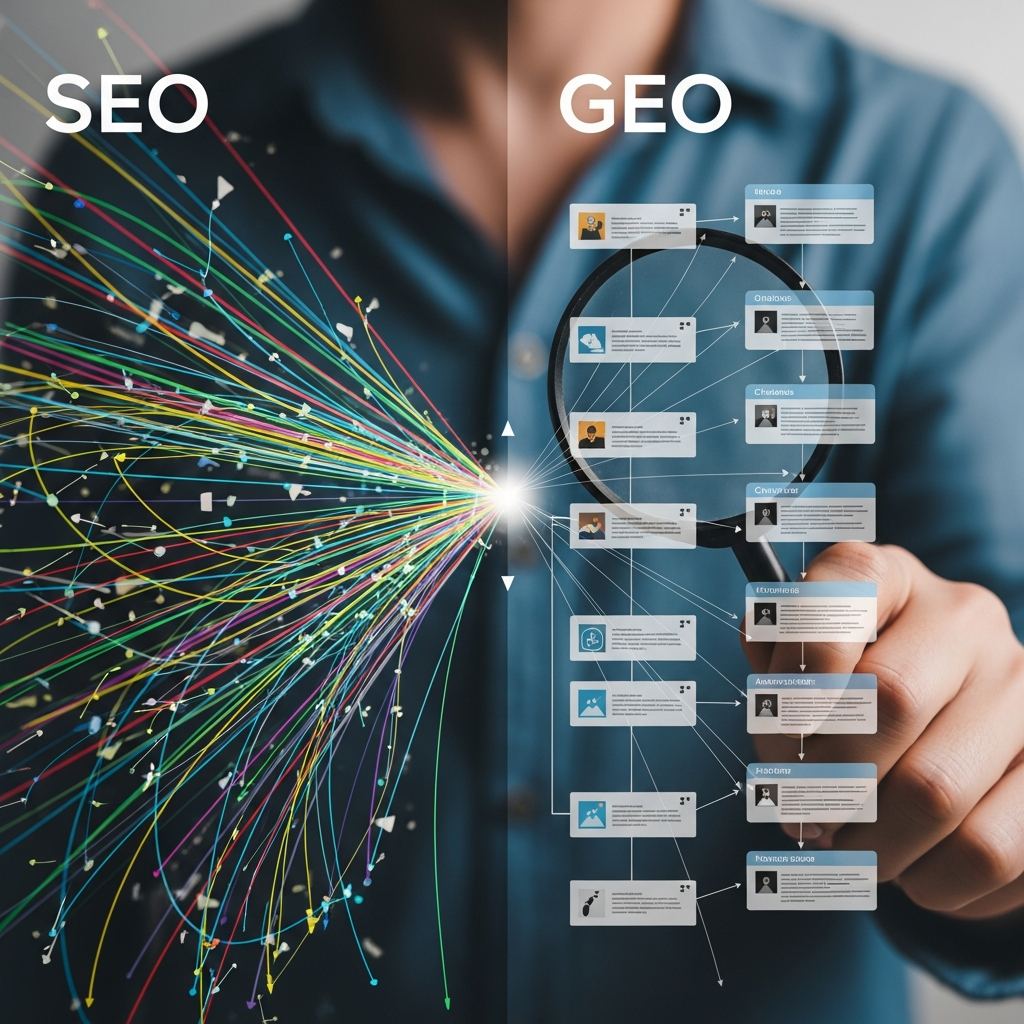
For over two decades, the world of digital marketing has revolved around a single, dominant mantra: get the click. Search Engine Optimization (SEO) has been the art and science of climbing the search engine results page (SERP), with the coveted #1 spot as the ultimate prize. The logic was simple and irrefutable: higher rankings lead to more clicks, more clicks mean more traffic, and more traffic translates to more leads and sales. This click-based economy has defined content strategies, shaped website designs, and fueled a multi-billion dollar industry of tools and experts. But a seismic shift is underway, one that is quietly rattling the very foundations of this established order. The familiar landscape of ten blue links is being terraformed by the powerful forces of generative AI. We are entering a new era where the click is being dethroned. SEO isn’t dead, but it is undergoing a profound evolution. The new goal isn’t just to be an option for a user to click on; it's to become the definitive source that an AI engine cites in its direct answer. Welcome to the age of Generative Engine Optimization (GEO), where visibility is measured not in clicks, but in authoritative citations.
The Old Guard of SEO: A World Built on Clicks
To understand the magnitude of the current shift, we must first appreciate the world it is replacing. Traditional SEO was a game of visibility and persuasion, played out on the digital battlefield of the Google SERP. The entire process was meticulously engineered to attract a human user’s attention and compel them to perform a single, crucial action: click on your link instead of a competitor's.
The core activities of this paradigm are familiar to any digital marketer:
- Keyword Research: The process began with identifying the specific phrases and questions your target audience was typing into the search bar. Tools like Ahrefs, SEMrush, and Google Keyword Planner were the compasses guiding this journey, helping to find terms with high search volume and manageable competition.
- On-Page Optimization: Once a keyword was chosen, the content and HTML source code of a page were tailored to signal its relevance to search engines. This involved strategically placing keywords in titles, headers, meta descriptions, and body copy, as well as optimizing images and ensuring a user-friendly site structure.
- Link Building: Backlinks—links from other websites to yours—served as votes of confidence in the eyes of search engines. A robust backlink profile from authoritative and relevant sites was, and still is, a powerful signal of trust, helping to push a site up the rankings.
The primary metric for success in this world was the Click-Through Rate (CTR). A high CTR for a given keyword indicated that your page title and meta description were compelling and relevant to the user's query. This, in turn, was a positive signal to Google, which could further boost your ranking. The entire ecosystem was a self-reinforcing loop: rank high, get clicks, prove relevance, and rank even higher. For businesses, this translated into a clear funnel. More organic traffic from clicks meant more potential customers entering their digital storefront, ready to be nurtured into a conversion. It was a predictable, measurable, and highly effective model for growth.
Enter the AI Overlord: The Rise of Generative Search
The predictable model of the ten blue links is now being disrupted by a technology that fundamentally changes the user's relationship with search. Generative AI, as seen in Google's Search Generative Experience (SGE), Perplexity AI, and the search capabilities of ChatGPT, doesn't just point you to potential answers—it provides a synthesized, direct answer right at the top of the page.
Imagine a user searching for "best hiking boots for rocky terrain." In the past, they would see a list of articles: "The 10 Best Hiking Boots of 2024," "A Podiatrist's Guide to Hiking Footwear," and so on. They would click on a few links, read the content, and make a decision. Today, with generative search, the user is likely to see a conversational, well-written paragraph first. This AI-generated snapshot will summarize the key features to look for, list a few top models with their pros and cons, and provide a concluding recommendation. Crucially, this answer is created by the AI ingesting and analyzing information from multiple websites. The user gets their answer instantly, without ever needing to perform the traditional "click."
This phenomenon accelerates the trend of "zero-click searches," a term used to describe search queries where the user's need is satisfied on the results page itself, through a featured snippet, a knowledge panel, or now, an AI-generated summary. For content creators and businesses that have built their entire strategy around capturing that click to drive traffic, this is a game-changing—and potentially terrifying—development. The digital front door they worked so hard to optimize is being bypassed entirely. Their content might be powering the answer, but they may not be getting the traffic they once relied on.
The New Digital Currency: Shifting from Clicks to Citations
As the value of the traditional click diminishes in this new landscape, a new form of digital currency is rising to take its place: the citation. It’s essential to understand the distinction between these two concepts in the context of generative search.
- A Click is a direct user action. A person sees your link on the SERP, finds it relevant, and physically clicks to navigate to your webpage. It is a direct measure of traffic acquisition.
- A Citation is an attribution. It's when the AI model references your website as a source for the information it used to construct its answer. It appears as a small link or footnote within or alongside the AI-generated text.
At first glance, a citation might seem like a consolation prize for a lost click. But in the GEO ecosystem, it holds a far more strategic and potent value. A citation is a public endorsement from the search engine itself. It tells the user, "This is the authoritative source we trusted to give you this answer." This carries immense weight and offers several key advantages over a simple click:
1. Authority by Association: Being cited directly positions your brand as an expert and a source of truth. Your name is displayed alongside the correct answer, building trust and brand recognition even if the user doesn't click through.
2. High-Intent Traffic: While overall traffic might decrease, the traffic you *do* get from a citation link is often from highly motivated users. These are individuals who have read the AI summary and want to dive deeper, investigate the source, or make a purchase. They are further down the decision-making funnel and are more qualified leads.
3. Brand Visibility in a Zero-Click World: In scenarios where a user gets their answer and leaves, a click-focused strategy yields zero value. A citation-focused strategy, however, still achieves a brand impression. The user sees your name, and that brand recall can pay dividends later on.
Think of it this way: A click is like someone picking your book off a shelf in a vast library. A citation is like a respected professor quoting your book in their lecture to a full auditorium. The first action gets you one reader; the second solidifies your reputation as an indispensable authority in your field.
From SEO to GEO: An Introduction to Generative Engine Optimization
This fundamental shift from clicks to citations requires a new methodology. We are moving from Search Engine Optimization (SEO) to Generative Engine Optimization (GEO). While they share some DNA, their core objectives and tactics are different.
SEO primarily optimizes for search engine crawlers and human user behavior to win a click. GEO optimizes for AI language models and knowledge graphs to win a citation. It’s about making your content not just discoverable, but also understandable, verifiable, and "synthesis-friendly" for an AI.
The pillars of GEO are built upon a foundation of demonstrating unimpeachable authority. The guiding principles include:
- E-E-A-T on Steroids: Expertise, Experience, Authoritativeness, and Trustworthiness are no longer just concepts for Google's quality raters. For an AI, they are the primary criteria for source selection. The AI needs to be confident that your information is accurate and comes from a credible source. This means content must be written by proven experts, backed by data, and reflect real-world experience.
- Structured Data and Semantic Markup: Schema markup and other forms of structured data are critical for GEO. This isn't just about helping Google display rich snippets; it's about explicitly telling the AI what your content *is*. Using `FAQPage` schema helps an AI understand a Q&A format, `HowTo` schema clarifies a set of instructions, and `Article` schema with clear author and citation properties helps establish provenance.
- Factual Accuracy and Verifiability: AI models are designed to cross-reference information from multiple sources to reduce "hallucinations" (inaccurate outputs). Your content must be factually impeccable. Citing your own sources, linking to academic studies, and referencing official data are no longer best practices—they are prerequisites for being trusted by the AI.
- Content Clarity and Structure: An AI needs to parse your content efficiently. This means clear, logical headings, concise paragraphs that directly answer a question, and the use of lists and tables to present information in a structured way. Well-organized content is easier for an AI to digest and synthesize into a coherent answer.
Your GEO Playbook: Actionable Steps for the New Era of Search
Adapting to GEO doesn't mean abandoning everything you know about SEO. It means enhancing and refocusing your efforts. Here is a practical playbook for thriving in the age of citations.
1. Become a Verifiable Source of Truth
Move beyond generic blog posts. The content most likely to be cited is that which provides unique, verifiable information. Focus on publishing original research, comprehensive case studies, data-driven reports, and expert-led analysis. Every claim should be backed by evidence. Enhance this by creating detailed author biographies that showcase their credentials and expertise, linking to their social profiles and other publications. This builds a web of proof that both users and AI can follow to verify your authority.
2. Master Structured Data and Semantic HTML
Implement a robust schema markup strategy. Go beyond the basics. If you're publishing a recipe, use `Recipe` schema. If you're reviewing a product, use `Product` and `Review` schema. This contextual layer of data is a direct communication line to the AI, telling it, "This piece of text is an answer to a specific question," or "This list of items represents the steps in a process." This dramatically increases the chances of your content being used accurately within a generative answer.
3. Build a Comprehensive Knowledge Graph
Think of your website as a digital encyclopedia for your niche. Develop topic clusters around core "pillar" pages that cover a broad subject, supported by "cluster" content that delves into specific sub-topics in detail. Use a meticulous internal linking strategy to connect these related concepts. This demonstrates to AI models that you have deep, comprehensive knowledge on a subject, making your domain a more reliable and "one-stop-shop" source for information, increasing the likelihood of being cited for a wide range of related queries.
4. Prioritize Brand Mentions and Digital PR
In the GEO world, an unlinked brand mention on a high-authority site can be as valuable as a traditional backlink. When an AI crawls the web, it sees these mentions as signals of your brand's relevance and authority within a specific context. Focus your digital PR efforts on getting your brand name, your experts, and your proprietary data mentioned and cited in industry publications, news articles, and academic papers. This builds a powerful reputation that AI algorithms are designed to recognize and reward.
5. Answer Questions, Don't Just Target Keywords
The very nature of generative AI is conversational. Users are increasingly phrasing their searches as full questions. Your content strategy should mirror this. Structure your articles around answering the core questions your audience has. Use headings that are phrased as questions (e.g., "What Are the Benefits of a Roth IRA?"). Use FAQ sections at the end of your articles, marked up with `FAQPage` schema. This makes your content a perfect, pre-packaged solution for an AI looking for a direct answer to a user's query.
Looking Ahead: What Happens After the Citation?
Winning a citation in an AI snapshot is the new battle, but the war for authority is a longer game. The future of search is conversational and continuous. A user's journey won't end with a single AI-generated answer; they will ask follow-up questions, request clarifications, and seek deeper insights. If your content was the source for the initial answer, you are in a prime position to be the source for the subsequent queries in that conversational thread. The goal is to become so deeply embedded as an authority on a topic that the AI defaults to your domain as its primary source of truth.
Ultimately, the most powerful outcome of a successful GEO strategy is a renaissance of brand building. When users repeatedly see your brand's name cited as the trusted source—whether it's for financial advice, technical tutorials, or product recommendations—they will start to bypass the generalized AI search altogether. They will begin their query with your name: "[Your Brand] review of the new iPhone" or "How to bake sourdough bread according to [Your Brand]." This direct, branded search is the holy grail. It signifies that you have transcended the search engine and have become the destination itself. This is the ultimate defense against the commoditization of information and the true sign of victory in the new era of search.
The transition from a click-centric world to a citation-centric one may seem daunting, but it represents a positive evolution for the web. SEO is not dead; it is being elevated. The age of generative search is moving us away from chasing algorithm loopholes and keyword-stuffing tactics and pulling us toward what should have always been the goal: creating genuinely expert, authoritative, and trustworthy content. The businesses and creators who will win in this new landscape are not those who are best at gaming the system for a click, but those who are dedicated to becoming the most reliable source of information. The focus is shifting from traffic acquisition to authority building. By embracing the principles of Generative Engine Optimization, you are not just adapting to a new algorithm; you are investing in the long-term trust and credibility of your brand. The future of search belongs to the cited, not the clicked. It’s time to start earning your citations.
More Tips For Website Improvement

2026
02Oct
White Label SEO, The Complete Guide to SEO Outsourcing
In today's hyper-competitive digital landscape, every business understands the critical need for online visibility. Search Engine Optimization (SEO) has evolved from a niche marketing tactic into a fundamental pillar of any successful business strategy. As a result,…

2026
30Sep
HTML Redirects, 301, and 302: A Guide for SEO
Welcome to the ultimate guide on setting up redirects for your website. In the dynamic world of web development and digital marketing, change is the only constant. Pages get updated, content is moved, and entire site structures can be revamped. When these changes…
2026
07Sep
GEO: How Generative AI is Reshaping Your Marketing Funnel
For decades, the marketing funnel has been a foundational concept, a reliable map guiding our efforts to turn strangers into customers. We meticulously crafted strategies for each stage—Awareness, Interest, Desire, Action—optimizing every touchpoint to gently…


