
In the rapidly evolving landscape of digital information, a new kind of oracle has emerged. Whether it’s Google’s AI Overview, Perplexity, or ChatGPT, we increasingly turn to Large Language Models (LLMs) for quick, synthesized answers to our most complex questions. We ask, and they provide a neat, coherent, and often impressively detailed response. It feels like magic. But it’s not. Behind every AI-generated paragraph is a complex process of aggregation, analysis, and synthesis, all built upon a foundation of pre-existing, human-created content. The magic, it turns out, is in the curation. But how does this curation work? Where do these LLMs actually get their information, and more importantly, why do they choose one source over another?
This article embarks on an investigative journey to pull back the curtain on this process. We will deconstruct a hypothetical but realistic AI-generated answer to a common and nuanced question. We won’t just look at the answer itself; we will trace its digital breadcrumbs back to the source citations. By examining the anatomy of these sources—from prestigious medical journals to high-quality health blogs—we will analyze the signals that make them attractive to an AI. This is more than just a technical exercise; it's a crucial exploration for anyone who creates content, relies on search engines, or is simply curious about the architecture of our new information age. Understanding why an AI chooses a specific page is to understand the future of search, content strategy, and what it means to be a trusted voice on the web.
Setting the Stage: Our Test Query and the AI's Answer
To begin our investigation, we need a query. It must be something that isn't a simple "yes" or "no" question, but rather a topic that requires nuance, balances different viewpoints, and relies on scientific evidence. Let's use a popular and complex health-related query that many people might ask an AI search tool like Perplexity.
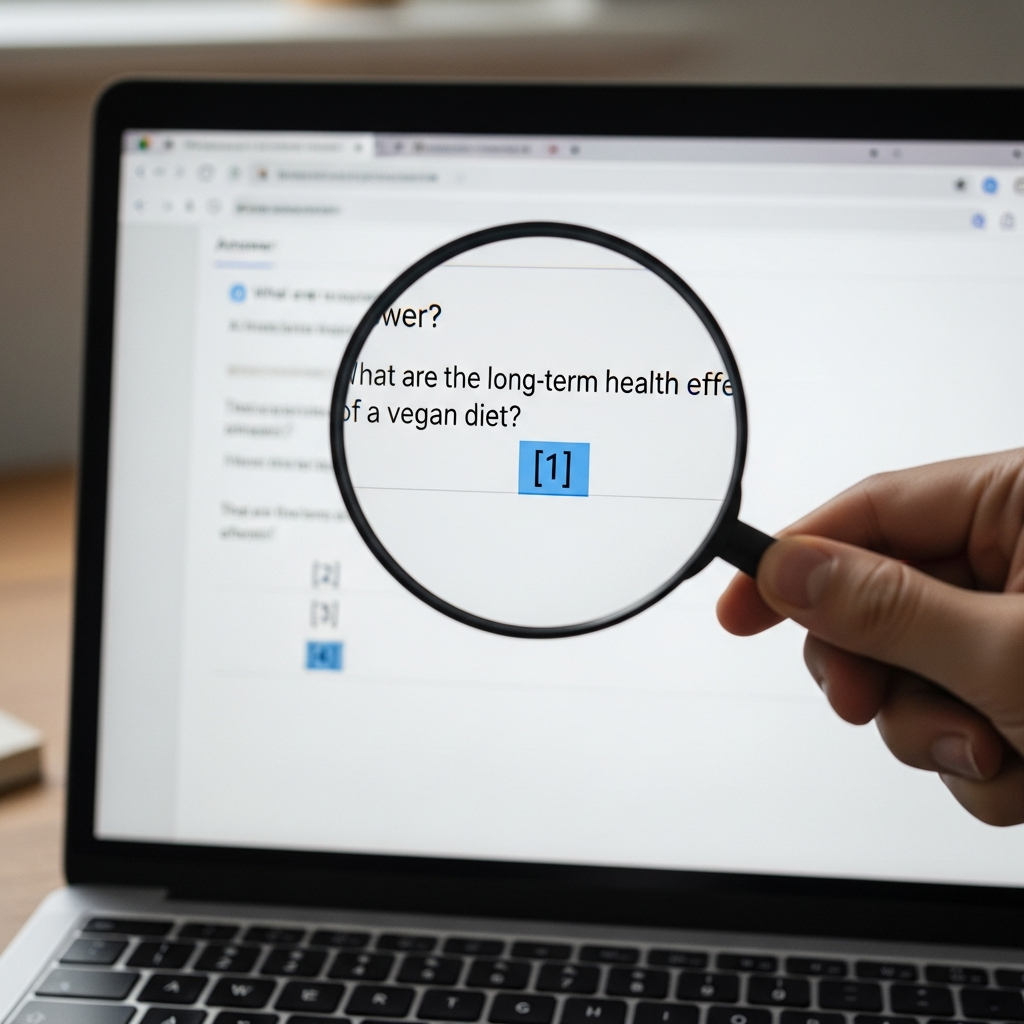
The Query: "What are the long-term health effects of a vegan diet?"
After a few moments, the AI generates a concise, well-structured summary. Let's imagine it looks something like this:
"A well-planned vegan diet can offer significant long-term health benefits, including a lower risk of chronic diseases. Research indicates that individuals following a vegan diet often have lower body mass index (BMI), blood pressure, and cholesterol levels, contributing to a reduced risk of heart disease and type 2 diabetes [1]. Specific studies have shown a notable decrease in the incidence of certain cancers [2]. However, a vegan diet requires careful planning to avoid potential nutrient deficiencies. Long-term vegans are at a higher risk for deficiencies in vitamin B12, iron, calcium, and omega-3 fatty acids, which are crucial for neurological function, bone health, and overall well-being [3]. Therefore, supplementation or consumption of fortified foods is often recommended to ensure a balanced nutritional intake [4]."
This is a solid, balanced answer. It presents both the pros and cons, cites its sources, and offers actionable advice. The numbers—[1], [2], [3], and [4]—are our entry points. These are the threads we will pull to unravel how this answer was constructed. Our task is to play detective and visit these hypothetical sources to understand the role each one played in the final synthesis.
Unpacking Citation 1: The Voice of Medical Authority
Let's imagine we click on the first citation, "[1]," which underpins the broad claims about lower BMI, blood pressure, and heart disease risk. The link takes us to a page on the Harvard T.H. Chan School of Public Health website, titled "The Nutrition Source: Vegetarian Diets."
Analyzing the Source Page:
The page is exactly what you’d expect from a world-renowned academic institution. It's clean, professional, and devoid of distracting advertisements. The content is written in clear, accessible language but is dense with information. It reviews the different types of vegetarian and vegan diets, systematically breaks down the health benefits, and cites its own sources from peer-reviewed medical journals. The authors are listed with their credentials (MD, PhD, MPH). The page was last reviewed within the last year, indicating it's current.
Why Was This Page Chosen?
The AI's choice of this Harvard page is a masterclass in recognizing E-E-A-T, a cornerstone of Google's search quality guidelines: Experience, Expertise, Authoritativeness, and Trustworthiness.
- Expertise and Authoritativeness: The ".edu" domain from a prestigious university like Harvard is one of the strongest signals of authority on the web. The content is written and reviewed by medical and public health experts.
- Trustworthiness: The institution's global reputation, its non-commercial nature, and its practice of citing primary research make it an incredibly reliable source. The AI's algorithm is trained to identify and prioritize these trust signals.
- Function in the AI's Answer: This source serves as the foundational pillar for the AI's response. It provides the broad, widely accepted consensus on the primary benefits of a vegan diet. The AI didn't need to piece this together from ten smaller blogs; it found a single, highly authoritative source that summarized the main points perfectly. It used this source to build the confident, opening statement of its answer.
Following the Data Trail: Citation 2 and the Research Study
Next, we investigate citation "[2]," linked to the more specific claim about a "notable decrease in the incidence of certain cancers." This link doesn't lead to a general health article but to a press release on the Loma Linda University Health website, summarizing a study published in a scientific journal.
Analyzing the Source Page:
The page is titled "Vegan Diets Associated with Lower Cancer Risk, Study Finds." It details the findings from the "Adventist Health Study-2," a famous long-term study on the health of Seventh-day Adventists, a population with a high percentage of vegetarians and vegans. The page quotes the lead researchers, provides specific statistics (e.g., "a 16% lower risk of all cancers"), and links directly to the study's abstract on PubMed, a database for biomedical literature.
Why Was This Page Chosen?
If the Harvard page was the foundation, this Loma Linda page is the specific, data-driven evidence. The AI chose it for several key reasons:
- Specificity: The AI's summary made a very specific claim about cancer. It needed a source to back up that exact point. A general article might mention cancer risk in passing, but this page is *about* that specific finding. The LLM is sophisticated enough to match claims with highly relevant evidence.
- Data-Centric Content: The page is filled with keywords and entities the AI is trained to value for scientific claims: "study," "researchers," "data," specific percentages, and the name of a well-known cohort study. It provides the "proof" for the AI's statement.
- Secondary Authority: While not a primary research paper itself, it's the next best thing for a general audience: a summary from the very institution that conducted the research. It acts as an authoritative translator of complex scientific findings, making it perfect for a synthesized public-facing answer. The link to PubMed further boosts its credibility.
This demonstrates the AI's ability to go beyond general summaries and pull in specific, data-backed evidence to add weight and credibility to its answer.
Citation 3: Balancing the Narrative with Potential Risks
A good answer is a balanced answer. Citation "[3]" supports the crucial counterpoint: the risk of nutrient deficiencies. Clicking this link takes us to a fact sheet from the National Institutes of Health (NIH) Office of Dietary Supplements, specifically the page for "Vitamin B12."
Analyzing the Source Page:
This page is clinical and direct. It's not an article or a blog post; it's a reference document. It has clear headings like "Sources of Vitamin B12," "Groups at Risk of Inadequacy," and "Health Risks from Excessive Vitamin B12." Under the "Groups at Risk" section, it explicitly lists vegetarians and vegans and explains precisely why their diets can lead to a deficiency. The information is dry, factual, and heavily referenced.
Why Was This Page Chosen?
The choice of an NIH fact sheet is strategic and reveals a lot about how the AI prioritizes information for health-related queries.
- Unimpeachable Authority: For health information in the United States, a ".gov" domain from the NIH is the gold standard of trustworthiness. There is no commercial interest, no editorial slant. It is purely informational. When discussing health risks, an AI will almost always defer to the highest possible authority to avoid providing dangerous misinformation.
- Factual and Unemotional Tone: The page simply states the facts about Vitamin B12. It doesn't frame veganism as "bad" or "good." This neutral, scientific tone is ideal for an LLM that aims to be objective. It can extract the necessary facts about deficiencies without having to interpret any emotional or persuasive language.
- Granularity: By linking to a page specifically about Vitamin B12 (and likely drawing from similar pages for iron and calcium), the AI can construct a very precise sentence about the *specific* nutrients of concern. It isn't just saying "vegans might miss some nutrients"; it's naming them, because it found a source that did the same.
Citation 4: The Role of the High-Quality Explainer
Finally, we arrive at citation "[4]," which backs the concluding advice that "supplementation or consumption of fortified foods is often recommended." This link directs us to a long-form article on Healthline, a major commercial health and wellness website, titled "How to Get All the Nutrients You Need on a Vegan Diet."
Analyzing the Source Page:
This article is a classic example of high-quality, SEO-optimized content. It's structured as a practical guide. It uses clear headings for each nutrient (Iron, Calcium, B12, etc.), bullet points to list vegan-friendly sources for each, and bold text to highlight key takeaways. Crucially, every health claim it makes is itself referenced with a little number, linking out to a primary scientific study. It is written by a registered dietitian, and the entire article is medically reviewed by a doctor, with their credentials clearly displayed.
Why Was This Page Chosen?
At first glance, a commercial blog might seem less authoritative than Harvard or the NIH. But it serves a unique and vital purpose for the AI.
- Synthesis and Structure: This page does the work of synthesis for the AI. It takes the "what" (the risk of deficiency from the NIH source) and provides the "how" (how to fix it). Its list-based format and clear headings make the information incredibly easy for an LLM to parse, understand, and summarize. The AI can effectively "borrow" the structure of the solution.
- Audience-Focused Language: The language is practical, positive, and action-oriented. It’s written to help a person, not just to state facts. This user-friendly tone is valuable for the AI, which aims to provide helpful, not just technically correct, answers.
- Demonstrated Trustworthiness: Despite being a commercial site, Healthline invests heavily in E-E-A-T signals. Citing primary sources, using qualified authors, and having a medical review process tells the AI's algorithm that this is not just any blog; it's a reliable secondary source that can be trusted to translate complex information accurately for a general audience.
The Grand Synthesis: Why These Sources and Not Others?
Looking at our four deconstructed sources, a clear pattern emerges. The AI did not randomly scrape the top four search results. It curated a portfolio of sources, each playing a distinct and complementary role in constructing the final answer.
- The Foundation (Harvard): A top-tier academic source to establish the broad, consensus benefits with maximum authority.
- The Evidence (Loma Linda): A research-specific source to provide a hard data point for a specific, quantifiable claim.
- The Counterpoint (NIH): An unimpeachable government source to present the risks and challenges with clinical objectivity.
- The Solution (Healthline): A high-quality, well-structured secondary source to provide actionable advice in an easy-to-digest format.
The AI's selection process was a sophisticated exercise in information triage. It prioritized authoritativeness for foundational and risk-related claims. It sought out specificity to back up its numbers. And it leveraged well-structured, user-friendly content to frame its actionable advice. It didn't choose four sources that all said the same thing. It chose four sources that, together, told the whole story. This is why well-structured, deeply researched, and authoritative content is more important than ever. Creating pages with clear headings, cited facts, and expert authorship makes your content not only better for human readers but also more legible and valuable to the AI systems that are increasingly becoming the gatekeepers of information.
Conclusion: The AI as a Mosaic Artist
Our investigation into a single, synthesized AI answer reveals a profound truth about our modern information ecosystem: AI-generated answers are not born from a void. They are mosaics, carefully assembled from the tiles of existing human knowledge published on the web. The LLM is the artist, but the quality of its creation is entirely dependent on the quality of the tiles it can find. Our deconstruction showed that the AI is a discerning artist, prioritizing sources that exhibit strong signals of expertise, authority, and trustworthiness. It selects a blend of sources not just for what they say, but for the function they serve—from providing a foundational overview and specific data to offering a balanced counterpoint and a practical solution.
For users, this understanding is a call to action. We must treat AI answers not as final proclamations but as expertly curated starting points. The real power lies in the citations. By clicking through and engaging with the sources, we can appreciate the nuance, evaluate the evidence for ourselves, and deepen our understanding far beyond the initial summary. For content creators, marketers, and publishers, the lesson is even clearer. The path to visibility in an AI-driven search world is not through keyword stuffing or technical tricks, but through the relentless pursuit of quality. Creating content that is authoritative, well-structured, deeply researched, and genuinely helpful is how you become one of the trusted tiles in the AI's mosaic. In the end, the new AI oracle still values an ancient human virtue: the earnest effort to create and share knowledge that is, above all, true and useful.
More Tips For Website Improvement
2026
07Sep
GEO: How Generative AI is Reshaping Your Marketing Funnel
For decades, the marketing funnel has been a foundational concept, a reliable map guiding our efforts to turn strangers into customers. We meticulously crafted strategies for each stage—Awareness, Interest, Desire, Action—optimizing every touchpoint to gently…
2026
17Aug
Future-Proof Your Content Strategy for an AI World
The ground is shifting beneath our feet. For years, content marketing has operated on a familiar set of rules: find the right keywords, create high-quality content, build links, and repeat. But the rise of sophisticated artificial intelligence, from generative text…

2026
24Jul
AI Personalization and Privacy: Building Customer Trust
We stand at a remarkable technological crossroads. On one side, we have the dazzling promise of generative artificial intelligence, exemplified by powerful large language models like Google's Gemini. This technology offers a future of hyper-personalization, where…


