
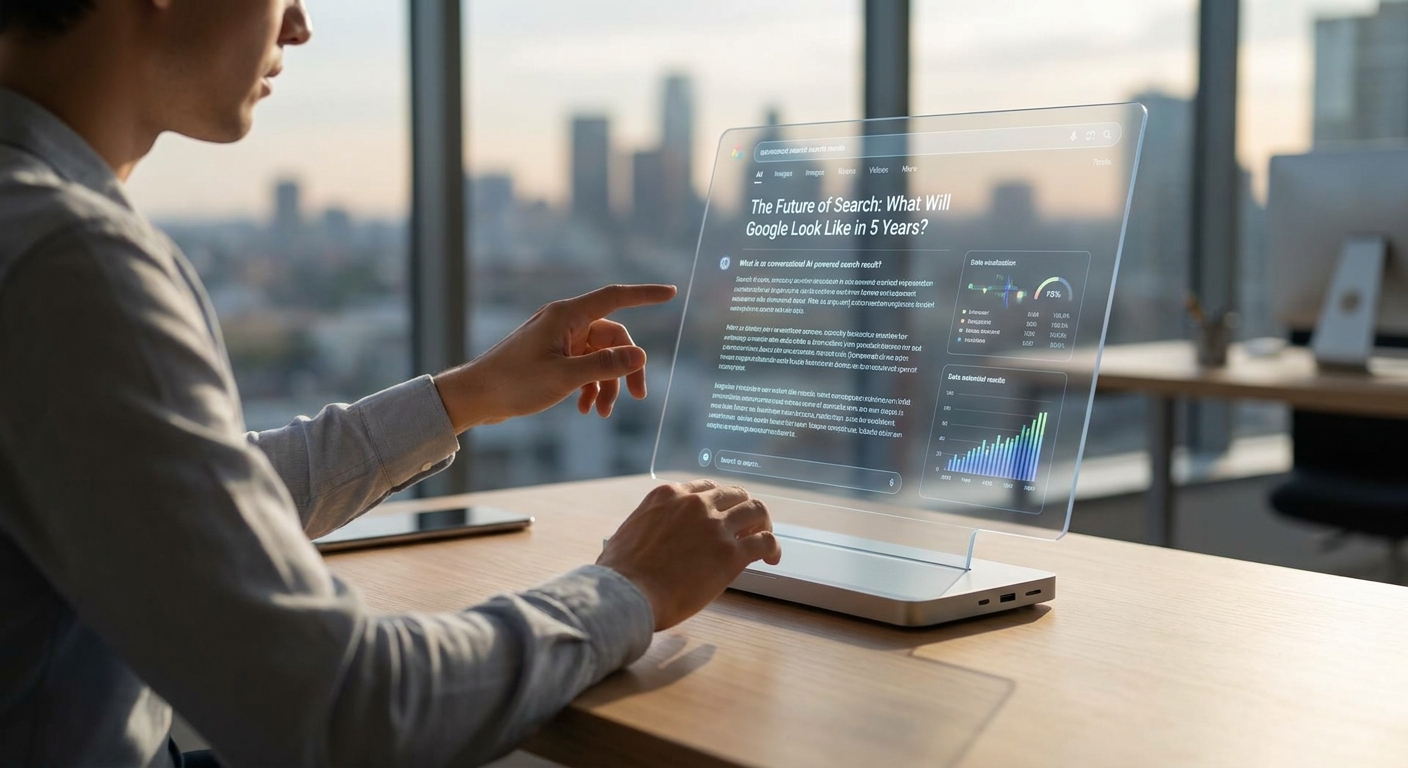
Cast your mind back a decade. When you needed an answer, you’d type a few keywords into a stark white search bar and receive ten blue links. Your job was to act as a digital detective, clicking through various sources, cross-referencing information, and piecing together the puzzle yourself. That era, the era of the hyperlink as king, is rapidly coming to a close. The subtle, yet seismic, shifts we’re seeing today—powered by advancements in artificial intelligence and large language models—are merely the opening tremors of a much larger earthquake set to reshape our entire digital information landscape. Google's rollout of its Search Generative Experience (SGE) is not just a new feature; it's a declaration of intent. It’s the first major step away from being a librarian that points you to the right aisle and towards becoming a concierge that reads all the books for you and delivers a personalized summary.
So, what does this mean for the future? In the next five years, the very concept of "Googling" something will be fundamentally redefined. We are on the precipice of a new paradigm where search is less about a list of results and more about a single, synthesized, and conversational answer. This article will explore this speculative future. We will delve into what Google could look like by the end of the decade, tackling the pressing questions on everyone’s mind. Will the humble hyperlink, the foundational building block of the web, become a relic? How will businesses advertise in a world without a prominent list of search results? And will our interactions with search engines evolve into fluid, natural conversations? Join us as we explore the exciting, and slightly unnerving, future of finding things out.
The AI-Powered Answer Engine: Beyond Ten Blue Links
The most immediate and profound change to Google search is its evolution from a "search engine" to an "answer engine." This isn't just a semantic difference; it represents a fundamental shift in its core function. For over two decades, Google's primary purpose was to index the web and rank pages based on relevance and authority, presenting you with a list of options. The cognitive load was on you, the user, to find the answer within those links. The future, which is already taking shape with SGE, flips this model on its head. Now, the cognitive load is on the AI.
In five years, the standard search results page for most informational queries won't be a list of links. It will be a dynamically generated, multi-faceted block of information. Imagine asking, "What are the pros and cons of intermittent fasting for someone over 40?" Instead of a list of health blogs and medical sites, you'll receive a direct, synthesized answer. This AI-generated response will:
- Provide a concise summary of the key benefits, such as improved metabolic health and cellular repair.
- Outline the potential risks, like nutrient deficiencies or impacts on hormonal balance, citing information from reputable medical journals.
- Incorporate different perspectives, perhaps mentioning different fasting protocols (like 16:8 vs. 5:2).
- Embed relevant media, such as a short video from a nutritionist or an infographic illustrating the process.
This "answer" is not copied from a single source. It's a unique composition, an amalgam of information synthesized from dozens of the most authoritative pages on the web. The goal is to resolve your query completely, right there on the results page, creating a new "zero-click" reality where the user never needs to leave Google's ecosystem to get their answer. This efficiency is the core value proposition, but it also sends a shockwave through the entire content creation industry, forcing us to ask a critical question: if users don't need to click, what happens to the websites that provide the information?
The Diminishing Role of the Hyperlink
This leads directly to one of the most debated topics among digital marketers and web creators: will links disappear? The short answer is no, but their role will be drastically diminished and transformed. The hyperlink will transition from being the primary product of a search to being a footnote—a citation or an option for a "deep dive." Its prominence in the user interface will shrink significantly.
Think of it like a research paper. The main text provides the complete argument and summary, while the footnotes and bibliography are there for those who wish to verify the sources or explore the topic in greater depth. In the search engine of 2029, the AI-generated answer is the main text. The links to the original sources will still exist, likely as small, clickable source cards or dropdown menus, but they will no longer be the main event. Users will only click through under specific circumstances:
- Verification: For sensitive topics (medical, financial), users will want to check the original source to ensure the AI's summary is accurate and trustworthy.
- Transactional Queries: When a user wants to buy a product, book a service, or sign up for a newsletter, they will need to click a link to land on the transactional page.
- In-Depth Research: For complex academic or professional research, a summary won't suffice. The user will need to access the original, long-form content.
This shift is also driven by Google's move toward "entity-based search." For years, Google has been building its Knowledge Graph, a massive database of "entities"—people, places, concepts, brands—and the relationships between them. It understands that "Leonardo da Vinci" painted the "Mona Lisa," which is housed in "The Louvre" in "Paris." By understanding the world this way, its reliance on the simple link graph as the main signal of authority and relevance decreases. Authority will be determined more by the credibility and factual accuracy of the information a source provides about an entity, not just by how many other sites link to it. For SEOs, this means the era of chasing backlinks purely for "link juice" is over. The new goal is to become an authoritative entity that the AI trusts and cites.
The New Frontier of Search Advertising
If the organic search results are being replaced by an AI summary, what happens to the ads that traditionally sit above them? The pay-per-click (PPC) model, which has been the bedrock of Google's multi-billion dollar empire, must inevitably evolve. Sticking a traditional text ad above a comprehensive AI answer will feel clunky and ineffective. The future of search advertising lies in seamless, native integration within the AI-generated content itself.
In five years, we can expect several new ad formats to become commonplace:
- Sponsored Mentions: Ads will appear as integrated suggestions within the AI answer. For a query like "best running shoes for flat feet," the AI might generate a list of features to look for and then add, "For a highly-rated option incorporating these features, many runners recommend the *Brand X Stability 5*." This mention would be clearly labeled as sponsored but would feel contextually relevant and helpful rather than intrusive.
- Integrated Commerce: For commercial queries, the line between answer and e-commerce platform will blur. A search for "best 4K TVs under $500" would generate an AI-powered comparison chart. Within this chart, there would be sponsored placements and "Buy Now" buttons that link directly to retail partners. The AI acts as a shopping assistant, and brands pay for premium placement within its recommendations.
- Conversational Ads: As search becomes more conversational, so will advertising. Imagine planning a trip with Google's AI assistant. After helping you draft an itinerary, it might say, "I see you're flying into Heathrow. *XYZ Car Service* is offering a 15% discount on airport transfers for your travel dates. Would you like me to book that for you?" The ad is a helpful, timely suggestion offered at the exact point of need.
This represents a monumental shift from bidding on keywords to bidding on *intents* and *moments*. Advertisers won't just be targeting "cheap flights"; they'll be targeting the moment a user is actively planning a vacation and needs a flight. This requires a much deeper understanding of the user journey and a more sophisticated approach to advertising, but it also promises ads that are genuinely useful to the consumer.
The Rise of Fully Conversational and Multimodal Search
The keyboard is slowly but surely becoming just one of many ways we interact with technology. The future of search is not just typing; it's talking, seeing, and gesturing. Within five years, search will become a fully conversational and multimodal experience, seamlessly blending different forms of input to understand our intent with astonishing accuracy.
This goes far beyond the simple voice commands we use today, like asking for the weather or to set a timer. The search of the future will be a true dialogue. Consider this potential interaction:
User (speaking): "Hey Google, I want to redecorate my living room. I'm going for a mid-century modern vibe."
Google (speaking): "I can help with that. To get started, can you use your phone's camera to show me the current layout of your room?"
(User pans their phone around the room.)
Google (displaying images on screen): "Okay, I see the dimensions and the current furniture. Based on the mid-century modern style, I've created three virtual design concepts for you. Concept A uses warmer wood tones, while Concept B is more minimalist. I've also found furniture and decor items that match each concept, all available from online retailers. You can tap on any item to see its price and details."
This is multimodal search in action. The user starts with a voice command (audio), provides visual context (video/image), and receives a rich, interactive response (visuals, text, links). The AI doesn't just understand the words "mid-century modern"; it understands the spatial context of the room and can apply that aesthetic to the user's specific environment. It can identify a chair in a photo you take on the street and not only tell you what it is but also where you can buy it or something similar. This fusion of inputs—voice, text, image, and video—will make search an intuitive extension of our own senses, capable of solving complex, real-world problems far beyond what a simple text query could ever achieve.
Personalization, Privacy, and the 'Filter Bubble' 2.0
To power this incredibly intuitive and helpful search experience, Google will need to know you better than ever before. The future of search is one of hyper-personalization. The AI assistant of 2029 won't just be using your search history and location; it will have a holistic understanding of your entire digital life. It will know your calendar, your travel plans from your Gmail, your shopping habits from Google Pay, and even your communication style from your chat history. When you ask for "a good place for dinner," it won't just give you a list of nearby restaurants. It will know you prefer spicy food, that you have a meeting across town at 8 PM, that your friend's birthday is next week, and that you have a coupon for an Indian restaurant in your email. Its recommendation will be a synthesis of all this data: "There's a highly-rated Indian place two blocks from your meeting that can seat you immediately. And don't forget you have that 20% off coupon."
This level of personalization is a double-edged sword. On one hand, it offers unparalleled convenience and creates a truly personal assistant. On the other, it raises profound privacy questions. How much of our digital soul are we willing to trade for a better dinner recommendation? The debate around data privacy will intensify, with users demanding more transparency and control over how their information is used to train and inform these AI models. Furthermore, this leads to the risk of a "Filter Bubble 2.0." The original filter bubble was about algorithms showing us content they thought we'd like, potentially shielding us from opposing viewpoints. An AI that synthesizes a single, authoritative-sounding "answer" based on our perceived preferences could be even more powerful in reinforcing our existing biases. If the AI knows you lean a certain way politically, will its summary of a current event be subtly tailored to that viewpoint? Ensuring objectivity, presenting diverse perspectives, and combating algorithmic bias will be one of the greatest ethical challenges for Google in the coming years.
The Future of SEO: From Ranking to Becoming the Source
With all these changes, it's easy to assume that Search Engine Optimization (SEO) will become obsolete. This couldn't be further from the truth. SEO isn't dying; it's undergoing its most significant evolution yet. The game is no longer about climbing a list of ten blue links. The new objective is to become the trusted, foundational source material that Google's AI uses to construct its answers.
The focus of SEO will shift from ranking to "informing." Businesses and content creators will need to adapt their strategies to feed the AI beast. The well-known E-E-A-T (Experience, Expertise, Authoritativeness, Trustworthiness) framework will likely expand. We might see the addition of a "P" for "Provability" or "Primary Source." Google's AI will prioritize information that is backed by original research, unique data, and clear, verifiable evidence. Future-proof SEO strategies will include:
- Creating Structured, Data-Rich Content: Content will need to be meticulously organized with clear headings, lists, and structured data (like schema markup). This makes it easier for AI to parse, understand, and extract key information. Think of your website less as a prose-filled article and more as a database of answers.
- Building True Brand Authority: Brand mentions, citations in authoritative publications, and recognition as a subject matter expert will become more valuable than a simple backlink. The goal is to make your brand synonymous with a topic, so the AI recognizes you as a primary source of truth.
- Optimizing for Conversational Queries: Content should be created to answer questions directly and naturally. Instead of targeting a keyword like "best running shoes," content will need to address the full conversational intent, such as "What are the best cushioned running shoes for a heavy runner with a history of shin splints?"
- Focusing on the Entire Funnel: With informational queries being handled by the AI, businesses must focus on creating best-in-class content for the consideration and conversion stages of the user journey—the parts that still require a click-through to a website for a deep dive or a transaction.
Essentially, SEO will become less about technical tricks and more about the purest form of content marketing: creating the absolute best, most authoritative, and most helpful information on a given topic, presented in a way that both humans and machines can understand with perfect clarity.
Conclusion: The Dawn of the Conversational Age
The Google of the next five years will be a far cry from the search engine we grew up with. The familiar list of links, the very architecture of the web as we know it, is giving way to a more integrated, intelligent, and conversational interface. We are moving from a tool that finds pages to an assistant that provides answers. This transition will see the role of the hyperlink evolve from a doorway into a footnote, forcing a complete rethinking of digital advertising, which will become more native and intent-driven than ever before. Our interactions will transcend the keyboard, embracing a multimodal future where we can speak, show, and gesture our way to complex solutions, all powered by a deep, hyper-personalized understanding of who we are. For users, this promises a future of incredible convenience and efficiency, where the world's information is available not just at our fingertips, but in a natural, ongoing dialogue.
However, this monumental shift is not without its challenges. It forces us to confront critical questions about privacy, data ownership, and the potential for algorithmic bias to create even more powerful echo chambers. For businesses, creators, and marketers, this is a pivotal moment. The old rules of SEO and digital visibility are being rewritten in real-time. The challenge is no longer just to rank, but to become an essential, trusted source in the AI's vast network of knowledge. The future of search is about contributing to the conversation. The companies and creators who learn how to speak the new language of AI—the language of structured data, provable authority, and genuine expertise—will be the ones whose voices are heard in the coming decade. The rest risk being drowned out by the single, synthesized voice of the answer engine.
More Tips For Website Improvement
2026
07Sep
GEO: How Generative AI is Reshaping Your Marketing Funnel
For decades, the marketing funnel has been a foundational concept, a reliable map guiding our efforts to turn strangers into customers. We meticulously crafted strategies for each stage—Awareness, Interest, Desire, Action—optimizing every touchpoint to gently…
2026
17Aug
Future-Proof Your Content Strategy for an AI World
The ground is shifting beneath our feet. For years, content marketing has operated on a familiar set of rules: find the right keywords, create high-quality content, build links, and repeat. But the rise of sophisticated artificial intelligence, from generative text…

2026
24Jul
AI Personalization and Privacy: Building Customer Trust
We stand at a remarkable technological crossroads. On one side, we have the dazzling promise of generative artificial intelligence, exemplified by powerful large language models like Google's Gemini. This technology offers a future of hyper-personalization, where…


