
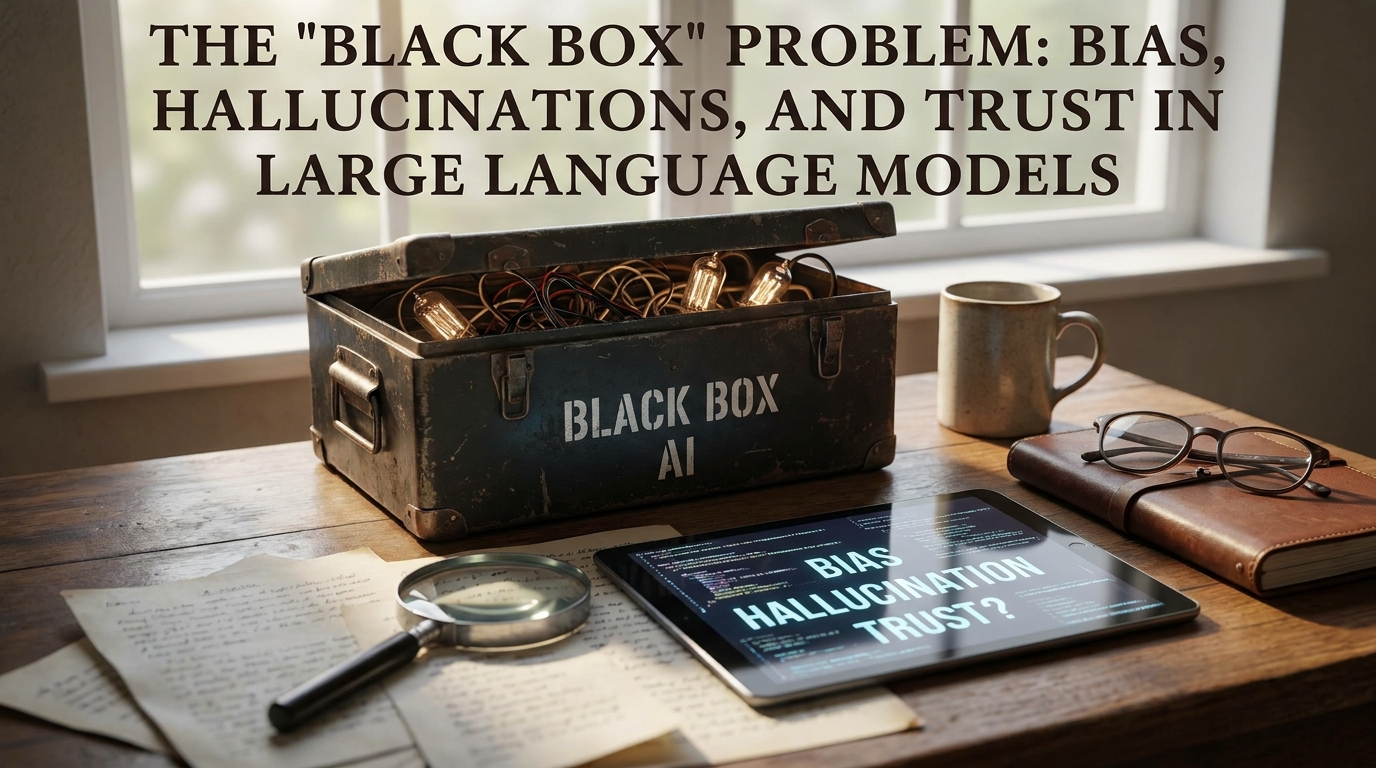
Large Language Models (LLMs) have exploded into the public consciousness, transforming from a niche concept in computer science to a household name. Platforms like ChatGPT, Google's Gemini, and Anthropic's Claude are revolutionizing how we create content, write code, and search for information. Their ability to generate human-like text, answer complex questions, and even engage in creative dialogue is nothing short of breathtaking. We stand at the cusp of a new technological era, one where interacting with artificial intelligence is as common as using a search engine. However, behind the curtain of this revolutionary technology lies a profound and complex challenge often referred to as the "black box" problem. While we can see the incredible outputs these models produce, the internal processes that lead to those results are deeply opaque, even to their creators. This lack of transparency is not merely a technical curiosity; it is the source of significant ethical dangers. These dangers manifest as ingrained algorithmic bias, the confident assertion of false information known as "hallucinations," and the growing risk of information monopolies. This article will delve into the heart of this black box, exploring the critical challenges we must confront to build a future where we can trust, and not just use, these powerful AI systems.
Peering Inside the Black Box: What Makes LLMs So Opaque?
When we talk about an LLM as a "black box," we aren't referring to a physical object. The term is a metaphor for a system whose inner workings are incomprehensible to human observers. We can provide an input (a prompt or question) and receive an output (a generated response), but the intricate journey from A to B is shrouded in a fog of immense complexity. The source of this opacity lies in the very architecture and scale of modern neural networks.
An LLM is built on a foundation of artificial neurons, organized into layers. A state-of-the-art model can have hundreds of billions, or even trillions, of parameters. These parameters are numerical values that are adjusted during the training process as the model analyzes vast datasets, often encompassing a significant portion of the public internet. During training, the model learns to recognize statistical patterns, relationships, and nuances in language. It learns the probability of which word should follow another in a given context.
The problem is that these learned patterns are not stored in a way that humans can easily interpret. There isn't a specific neuron for "cat" or a set of parameters that cleanly defines the concept of "justice." Instead, these concepts are distributed across millions of interconnected parameters in an abstract, high-dimensional space. While engineers understand the mathematical principles behind the model's architecture, like the "transformer" and its "attention mechanism," they cannot point to a specific part of the network and say, "This is why the model chose the word 'elegant' instead of 'beautiful' in this sentence." The reasoning is emergent, a result of the colossal interplay of all its parts. This fundamental inscrutability is the root cause of many of the ethical challenges that follow, because if we don't understand why a model says what it says, it becomes incredibly difficult to predict, prevent, or correct its failures.
The Echo Chamber Effect: How Algorithmic Bias is Baked In
One of the most immediate and damaging consequences of the black box problem is algorithmic bias. An LLM is not born with a sense of fairness or an understanding of social equity; it is a reflection of the data it was trained on. Since these models are trained on massive swathes of text and data from the internet, they inevitably absorb, replicate, and often amplify the biases present in human society.
This training data contains the full spectrum of human expression: centuries of literature, encyclopedias, news articles, forum discussions, and social media posts. It also contains our documented history of prejudice, stereotypes, and systemic inequalities. The LLM learns these associations not as moral failings but as statistical patterns. For example:
- Gender Bias: If historical data predominantly associates doctors with men and nurses with women, the LLM will learn this pattern. When prompted to write a story about a "doctor," it will be statistically more likely to use male pronouns, reinforcing outdated stereotypes.
- Racial and Ethnic Bias: If certain minority groups are disproportionately represented in negative contexts (like crime reports) in the training data, the model can learn to associate those groups with negative attributes, leading to biased and harmful content generation.
- Cultural Bias: The majority of training data is in English and originates from Western, developed nations. This leads to a model that inherently prioritizes Western perspectives, cultural norms, and historical accounts, often marginalizing or misrepresenting other worldviews.
The danger here is twofold. First, the LLM presents these biased outputs with an air of objective authority, laundering human prejudice through a technological filter. Second, as these models are integrated into critical systems—for tasks like screening resumes, assisting in legal research, or even generating news articles—this baked-in bias can perpetuate and scale up discrimination in a way that is both insidious and difficult to challenge. Because of the black box nature, developers can't simply go in and "remove the bias" parameter. Correcting it is a complex and ongoing process of data curation, fine-tuning, and implementing safety guardrails, but it remains a fundamental challenge.
When AI Dreams: Understanding and Confronting "Hallucinations"
Perhaps one of the most unsettling and trust-eroding behaviors of LLMs is the phenomenon known as "hallucination." This doesn't mean the AI is having a psychedelic experience. In the context of AI, a hallucination is the model's tendency to generate information that is plausible-sounding, grammatically correct, and contextually relevant, but factually incorrect or entirely fabricated. The LLM presents this falsehood with the same level of confidence as it would a verifiable fact.
To understand why this happens, we must remember that an LLM is a probabilistic text generator, not a knowledge database. It doesn't "know" anything in the human sense. Its core function is to predict the next most likely word in a sequence based on the patterns it learned during training. A hallucination occurs when the most statistically probable sequence of words does not align with reality. For instance, if you ask an LLM for legal cases supporting a niche argument, it might invent case names and citations that look completely authentic because the structure and language of its response match real legal documents. It's simply generating the "shape" of a correct answer without access to the factual substance.
The consequences of hallucinations can range from comical to catastrophic:
- A student might cite a non-existent academic paper in their thesis.
- A journalist on a deadline might include a fabricated quote in an article.
- A lawyer might build a legal argument around a hallucinated court precedent, leading to professional disaster.
- A person seeking medical information might receive confidently delivered but dangerously incorrect advice.
This problem directly attacks the foundation of trust. If an information tool cannot be relied upon to provide factual information, its utility is severely compromised. It shifts the burden of verification entirely onto the user, who must treat every single output with skepticism and diligently cross-reference it with reliable primary sources. For casual users, this critical step is often overlooked, creating a powerful engine for the spread of misinformation.
The Trust Deficit: Why We Can't Take LLM Outputs at Face Value
The combined issues of hidden bias and factual hallucinations create a significant "trust deficit." We are naturally inclined to trust information that is presented clearly, confidently, and authoritatively. LLMs are masters of this presentation. They generate text with perfect grammar and a formal, knowledgeable tone, creating a powerful veneer of credibility. This illusion of authority makes it easy to accept their outputs without question, a tendency that is both understandable and incredibly risky.
Building a healthy relationship with this technology requires a fundamental shift in mindset. We must move from being passive consumers of information to active, critical interrogators. Relying on an LLM as an infallible oracle is a recipe for disaster. Instead, it should be viewed as a powerful but flawed assistant—a starting point for research, a brainstorming partner, or a tool for drafting, but never the final arbiter of truth.
To navigate this trust deficit, users should adopt a set of best practices:
- Assume it could be wrong. Approach every output with a healthy dose of skepticism. The more critical the information, the higher your level of scrutiny should be.
- Verify, then trust. Always cross-reference important facts, figures, dates, and quotes with primary sources. Use the LLM to find leads, but use trusted encyclopedias, academic journals, and reputable news outlets to confirm them.
- Understand the prompt's power. The way you frame a question can influence the output. Be aware of your own confirmation bias, and try phrasing questions in neutral terms to get a more balanced response.
- Never use it for high-stakes advice. Do not rely on an LLM for critical medical, legal, or financial advice. These fields require nuanced expertise and an understanding of individual context that these models simply do not possess.
Ultimately, the responsibility for verification rests with the human user. Until we have models that can reliably cite their sources and distinguish fact from statistical fabrication, the mantra must be: "Trust, but verify"—with a heavy emphasis on "verify."
The New Gatekeepers: LLMs and the Risk of Information Monopolies
Beyond the technical challenges of bias and hallucinations lies a systemic, societal risk: the concentration of power and the rise of information monopolies. Developing, training, and deploying a state-of-the-art Large Language Model is an astronomically expensive undertaking. It requires massive, curated datasets, immense computational power equivalent to that of a supercomputer, and teams of highly specialized and sought-after AI researchers.
This reality means that only a handful of trillion-dollar tech corporations—primarily Google, Microsoft (through its partnership with OpenAI), and a few other heavily-funded players—have the resources to build at the cutting edge. This concentration of power in the hands of a few private entities creates a new and potent form of gatekeeping. For decades, we worried about search engines shaping our access to information. LLMs represent a quantum leap in that dynamic.
Instead of providing a list of links for us to evaluate, these models synthesize information and present a single, narrative answer. This gives the model's creators enormous, albeit subtle, influence over public discourse. The choices they make about training data, the values they instill through "safety tuning," and the topics they deem off-limits all shape the information landscape for millions of users. If a few dominant models become our primary interface for knowledge, whose perspectives will be centered? Whose will be marginalized? What happens when commercial or political interests influence the model's responses? This centralization risks creating a homogenized information ecosystem, where a few corporate-defined worldviews are presented as objective truth, potentially stifling dissent, erasing nuance, and making it harder for diverse ideas to flourish.
Navigating the Future: Towards a More Responsible and Transparent AI
Confronting the challenges of the black box is not about halting progress or abandoning this transformative technology. Instead, it is about charting a course toward a more responsible, transparent, and human-centric AI ecosystem. Researchers, developers, and policymakers are actively working on solutions to chip away at the opacity and mitigate the associated harms.
Several key areas of development offer hope for a better future:
- Tackling Bias: Efforts are underway to create more diverse and representative training datasets. Advanced techniques are being developed to audit models for bias and "debias" their outputs during fine-tuning. "Red-teaming," where experts actively try to make a model produce harmful content, helps identify and patch vulnerabilities before deployment.
- Grounding Hallucinations: A promising technique called Retrieval-Augmented Generation (RAG) is gaining traction. RAG systems connect the LLM to a specific, verifiable body of knowledge (like a company's internal documents or a collection of medical journals). When asked a question, the model first retrieves relevant information from this trusted source and then uses its language capabilities to formulate an answer based only on that information, dramatically reducing hallucinations.
- Increasing Transparency: The push for "Explainable AI" (XAI) aims to develop methods for peering inside the black box and understanding a model's decision-making process. While still a nascent field, its goal is to make AI reasoning auditable. In the meantime, initiatives like "Model Cards" and "Data Sheets" are becoming standard practice. These are documents that accompany an AI model, describing its intended uses, limitations, training data, and known biases, giving users a much clearer picture of the tool they are working with.
Beyond these technical fixes, the human element remains paramount. Robust regulatory frameworks are needed to ensure accountability and set standards for safety and fairness. Public education is essential to foster AI literacy, teaching users to be critical consumers of AI-generated content. Ultimately, the responsibility is shared. Developers must build with ethics at the forefront, deployers must implement these tools responsibly, and users must engage with them critically.
Conclusion: Demanding More From Our Digital Minds
Large Language Models represent a monumental leap in our ability to harness the power of information. They are remarkable tools for creativity, productivity, and discovery. Yet, as we have explored, their "black box" nature conceals profound challenges that we ignore at our peril. The algorithmic biases learned from our own flawed history, the confident fabrications of AI hallucinations, and the looming spectre of information monopolies controlled by a few tech giants are not minor glitches; they are fundamental issues that strike at the heart of our trust in technology and in the information we consume. We are at a critical inflection point, where the decisions we make today will shape the role of AI in our society for decades to come. Blindly embracing these systems without demanding transparency and accountability is a path fraught with risk. Conversely, rejecting them outright would be to forsake their immense potential for good. The path forward requires a middle way: a posture of engaged, critical optimism. We must champion the innovation while relentlessly pushing for greater transparency, fairness, and human oversight. Our goal should not be to simply build more powerful AI, but to build AI we can understand and, ultimately, trust. The future of a healthy, informed, and equitable digital society depends on it.
More Tips For Website Improvement

2026
07Sep
GEO: How Generative AI is Reshaping Your Marketing Funnel
For decades, the marketing funnel has been a foundational concept, a reliable map guiding our efforts to turn strangers into customers. We meticulously crafted strategies for each stage—Awareness, Interest, Desire, Action—optimizing every touchpoint to gently…

2026
17Aug
Future-Proof Your Content Strategy for an AI World
The ground is shifting beneath our feet. For years, content marketing has operated on a familiar set of rules: find the right keywords, create high-quality content, build links, and repeat. But the rise of sophisticated artificial intelligence, from generative text…

2026
24Jul
AI Personalization and Privacy: Building Customer Trust
We stand at a remarkable technological crossroads. On one side, we have the dazzling promise of generative artificial intelligence, exemplified by powerful large language models like Google's Gemini. This technology offers a future of hyper-personalization, where…


