
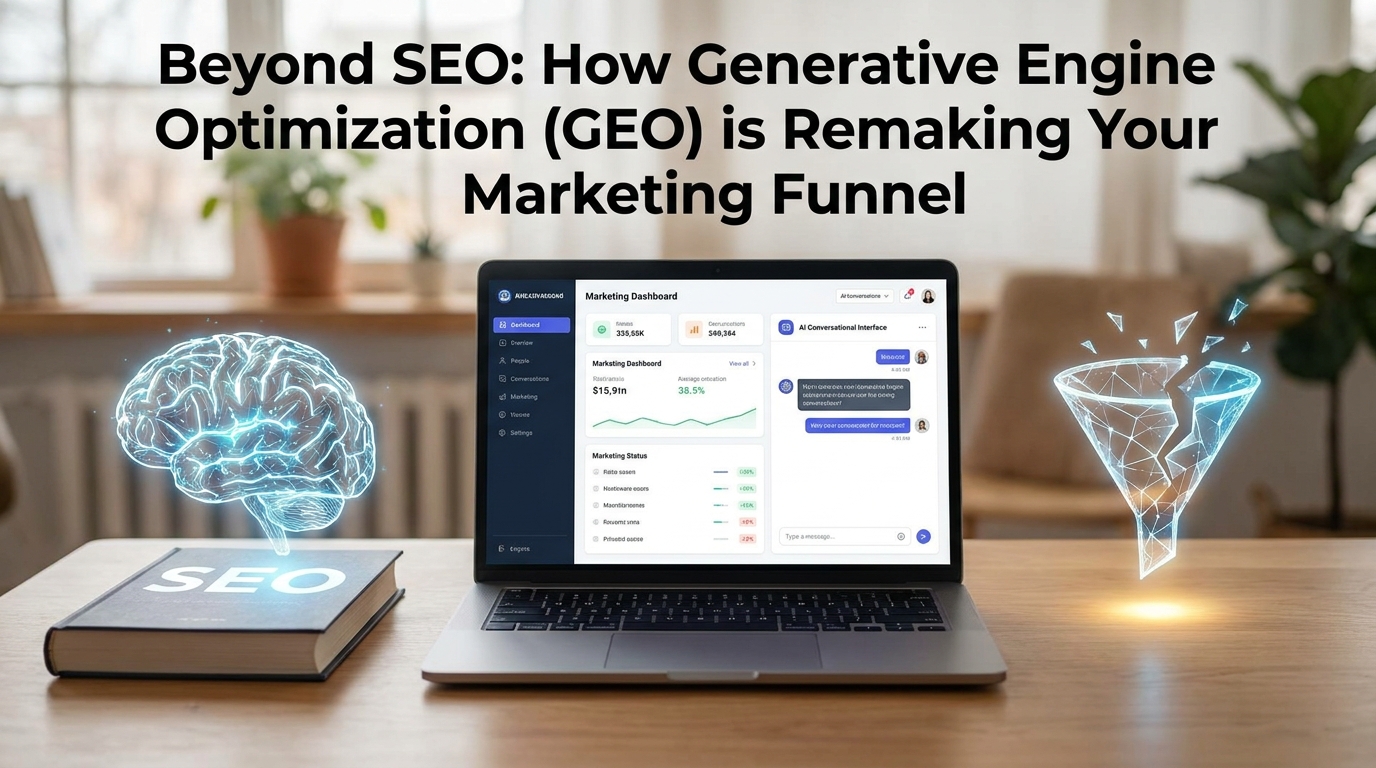
For decades, the marketing funnel has been a foundational concept, a reliable map guiding our efforts to turn strangers into customers. We meticulously crafted strategies for each stage—Awareness, Interest, Desire, Action—optimizing every touchpoint to gently nudge prospects along a predictable path. The digital age supercharged this model with SEO, content marketing, and paid ads, all designed to capture attention and direct traffic down the funnel. But a new technological earthquake is rumbling, one so powerful it's not just shaking the funnel but fundamentally reshaping its very structure. This force is generative artificial intelligence. The rise of conversational AI like ChatGPT, Google's Search Generative Experience (SGE), and Perplexity is creating a new information ecosystem. Customers are no longer just searching; they're conversing with an AI that summarizes, compares, and recommends. This paradigm shift demands more than a simple update to our SEO tactics; it requires a whole new discipline: Generative Engine Optimization (GEO). This article will dissect the traditional marketing funnel, stage by stage, to reveal how generative AI is rewriting the rules and what you must do to adapt, survive, and ultimately thrive in this new era.
The Old Funnel vs. The New Conversational Reality
The traditional marketing funnel, often visualized as a cone, represents a linear, predictable journey. At the wide top, you cast a broad net to create Awareness. As you move down, you nurture Interest and Desire with targeted content, eventually leading a smaller, qualified group to the narrow bottom to take Action, or convert. This model places the marketer in the driver's seat, controlling the messaging and the path. It’s a model built for a world of static web pages and search engine results pages (SERPs) where the goal was to secure a top-ranking blue link.
Generative AI shatters this linear model. The customer journey is no longer a step-by-step progression through your carefully designed funnel. Instead, it’s a dynamic, interactive conversation with an AI model. A single, complex query can now take a user from initial awareness straight to a purchase decision. The power has shifted from the marketer who designs the funnel to the user who crafts the prompt. This is where Generative Engine Optimization (GEO) comes in. GEO is the next evolution of search optimization. It’s the practice of structuring your brand’s information, content, and data in a way that is not just discoverable by a search engine, but is also easily understood, interpreted, trusted, and synthesized by a generative AI. The goal of GEO is no longer just to rank; it’s to become a foundational, citable source in the AI's generated response.
The Awareness Stage Reimagined: From Keywords to AI Citations
In the old world, the Awareness stage was a battle for visibility. The primary KPIs were search rankings, impressions, and website traffic. You won this stage by mastering keyword research and getting your content to the top of the SERP. In the age of generative AI, the top of the funnel looks radically different. Awareness is no longer about a user simply seeing your brand name in a list of search results. It’s about your brand, product, or data being explicitly mentioned and cited within an AI-generated answer.
Imagine a user asking their AI assistant, "What are the most effective project management tools for a small remote team?" The AI won't just provide a list of links. It will deliver a synthesized paragraph summarizing the top options, their key features, and their ideal use cases. Your new goal is to have your tool featured in that summary, complete with a citation linking back to your site. Achieving this requires a profound shift in content strategy.
How to Optimize for AI Awareness:
- Emphasize Factual Accuracy and Authority: AI models are being trained to recognize and prioritize information from sources that demonstrate deep expertise, authoritativeness, and trustworthiness (the E-E-A-T principles of Google, now with an added "Experience"). Your content must be meticulously researched, data-backed, and factually verifiable. Original research, industry reports, and case studies become invaluable assets.
- Structure for a Machine Audience: While your content must still engage humans, it also needs to be easily digestible for AI. Use clear, hierarchical headings (H3, H4), bullet points, and numbered lists. Employ Schema markup to explicitly label entities like products, articles, and FAQs. This structured data acts like a clear set of instructions for the AI, helping it understand the context and specifics of your information.
- Answer Questions, Don't Just Target Keywords: The nature of search is becoming more conversational. Your content should be built to answer specific questions your audience has. Think about the entire spectrum of a topic and create a comprehensive resource that addresses it from multiple angles. This "topic cluster" approach positions you as an authority, making your content a prime candidate for AI synthesis.
The Consideration Stage: AI as the Ultimate Product Reviewer
The middle of the funnel—Consideration—has always been the most complex. This is where potential customers compare options, read reviews, and weigh pros and cons. Traditionally, this involved a messy process of opening a dozen browser tabs, reading blog posts, and trying to synthesize conflicting information. Generative AI streamlines this entire process into a single query. A user can now simply ask, "Compare the Sony WH-1000XM5 and the Bose QC Ultra headphones on noise cancellation, battery life, and price." The AI will instantly crawl the web, aggregate specifications, summarize user reviews, and present a neat, comparative table.
This transforms the consideration stage from a scavenger hunt into a direct consultation with a seemingly omniscient expert. For marketers, this means the battlefield is no longer just about having a better landing page; it's about having the most clear, accurate, and positively reinforced data footprint across the entire internet.
Winning the AI-Driven Comparison:
- Meticulous Product Data: Your product pages and technical specification sheets must be flawless and machine-readable. Use product schema to clearly define every feature, dimension, price, and compatibility metric. If your data is unclear or missing, the AI will simply ignore you in its comparison.
- Reputation is Everything: The AI will not just look at your website. It will synthesize sentiment from customer reviews on Amazon, G2, Reddit, and forums. A consistent pattern of negative feedback can quickly disqualify you from the AI's recommendation. Proactive reputation management and encouraging genuine positive reviews are more critical than ever.
- Create Objective Comparison Content: Don't be afraid to create content that compares your product to your competitors'. If done fairly and backed by data, your own content can become a primary source for the AI's analysis. This allows you to frame the comparison around your strengths, as long as you maintain objectivity and trust.
The Conversion Stage: A Seamless, Conversational Path to Purchase
The bottom of the funnel is where the decision is made and the purchase happens. Traditionally, this stage involved optimizing call-to-action buttons, streamlining checkout forms, and using retargeting ads to bring back hesitant buyers. While these elements remain important, AI introduces a powerful conversational layer that can dramatically reduce friction and boost conversion rates.
Instead of a user clicking through a static funnel, they can now convert within a conversation. An AI-powered chatbot on your website can do more than just answer basic questions. It can act as a personal shopping assistant. A user might say, "I need a durable, waterproof jacket for hiking in the Pacific Northwest, and my budget is around $300." A sophisticated AI can analyze the query, recommend 2-3 specific products from your catalog, show them in the user's preferred color, answer follow-up questions about materials, and then provide a direct link to a pre-populated checkout cart. The journey from consideration to conversion becomes a single, fluid interaction, removing a dozen potential drop-off points. This personalized, concierge-like experience is the new gold standard for conversion optimization.
Beyond the Sale: AI-Powered Loyalty and Advocacy
The marketing funnel shouldn't end at the point of sale. The most valuable customers are the ones who return and become advocates for your brand. The Loyalty stage is where AI can have a truly transformative impact, shifting customer relationships from reactive to proactive and hyper-personalized.
Building Loyalty in the AI Era:
- Intelligent Customer Support: AI-driven chatbots can provide instant, 24/7 support for common issues, from tracking an order to troubleshooting a product feature. This immediate assistance improves customer satisfaction and frees up human support agents to focus on high-value, complex problems that require empathy and critical thinking.
- Personalized Onboarding and Education: After a purchase, an AI can guide a new customer through a personalized onboarding process. Based on their initial usage or stated goals, it can generate custom tutorials, offer relevant tips, and suggest advanced features, ensuring the customer gets the maximum value from your product or service.
- Predictive Engagement: By analyzing customer data, AI can identify patterns that predict churn or signal an opportunity for an upsell. It can then trigger automated yet personalized outreach. For example, it might send a helpful guide to a customer who seems to be struggling with a feature or offer a loyalty discount to a customer whose subscription is nearing its renewal date. This proactive engagement makes customers feel seen and valued.
Your GEO Playbook: Practical Steps to Adapt for the AI Revolution
Understanding the theoretical shifts is one thing; implementing a new strategy is another. The transition to a GEO-focused mindset requires deliberate, actionable steps. Here is a practical playbook to help you begin adapting your marketing for the age of generative AI.
1. Conduct a Comprehensive AI Audit: Before you can optimize, you need a baseline. Go to the major generative AI platforms (ChatGPT, Google's SGE, Perplexity, etc.) and start asking the questions your target audience would.
- "What are the best [your product category]?"
- "Compare [your product] and [competitor product]."
- "How do I solve [problem your product solves]?"
Document where your brand appears, how it's described, and whether the information is accurate. This audit will reveal your biggest vulnerabilities and opportunities.
2. Elevate Your Content with E-E-A-T: Now, more than ever, your content must be a bastion of Experience, Expertise, Authoritativeness, and Trustworthiness. This means showcasing author bios with real credentials, citing primary sources, updating content regularly to ensure accuracy, and publishing original data and insights that can't be found elsewhere.
3. Become Fluent in Structured Data: Implement robust Schema markup across your entire website. This isn't just for rich snippets anymore; it's about feeding AI models clean, structured information they can easily parse. Use Product, Article, FAQ, How-to, and Organization schema to clearly define every piece of content on your site.
4. Reimagine Content as a Conversation: Shift your content strategy from targeting isolated keywords to building comprehensive topic clusters. Think of every piece of content as an answer to a potential question in a larger conversation. Use natural language, anticipate follow-up questions, and aim to be the most complete resource on a given subject.
Conclusion: Navigating the Future of Marketing
The traditional marketing funnel, a steadfast guide for generations of marketers, is not disappearing, but it is being fundamentally disrupted and reshaped by the powerful currents of generative AI. We are moving from a linear, marketer-controlled path to a dynamic, conversational customer journey mediated by intelligent engines. This is not a distant future; it is happening right now. The shift requires us to evolve our thinking from Search Engine Optimization (SEO) to the more holistic practice of Generative Engine Optimization (GEO). At the Awareness stage, success is no longer about ranking first but about being cited as a trusted source within an AI's answer. In the Consideration phase, the battle is won with clean, structured data and an impeccable online reputation that an AI can synthesize into a favorable comparison. The Conversion stage is becoming a frictionless, personalized dialogue, and the Loyalty loop is being transformed by proactive, AI-driven engagement. This new landscape may seem daunting, but it presents an incredible opportunity. The marketers and brands who will thrive are not those who fear this technology, but those who embrace it. By focusing on creating genuine value, building unwavering authority, and learning to structure information for both human and machine audiences, we can harness the power of AI to build stronger customer relationships and more efficient, meaningful marketing funnels than ever before.
More Tips For Website Improvement

2026
17Aug
Future-Proof Your Content Strategy for an AI World
The ground is shifting beneath our feet. For years, content marketing has operated on a familiar set of rules: find the right keywords, create high-quality content, build links, and repeat. But the rise of sophisticated artificial intelligence, from generative text…

2026
24Jul
AI Personalization and Privacy: Building Customer Trust
We stand at a remarkable technological crossroads. On one side, we have the dazzling promise of generative artificial intelligence, exemplified by powerful large language models like Google's Gemini. This technology offers a future of hyper-personalization, where…

2026
20Jul
AI’s Black Box: Bias, Hallucinations, and Trust
Large Language Models (LLMs) have exploded into the public consciousness, transforming from a niche concept in computer science to a household name. Platforms like ChatGPT, Google's Gemini, and Anthropic's Claude are revolutionizing how we create content, write…


