
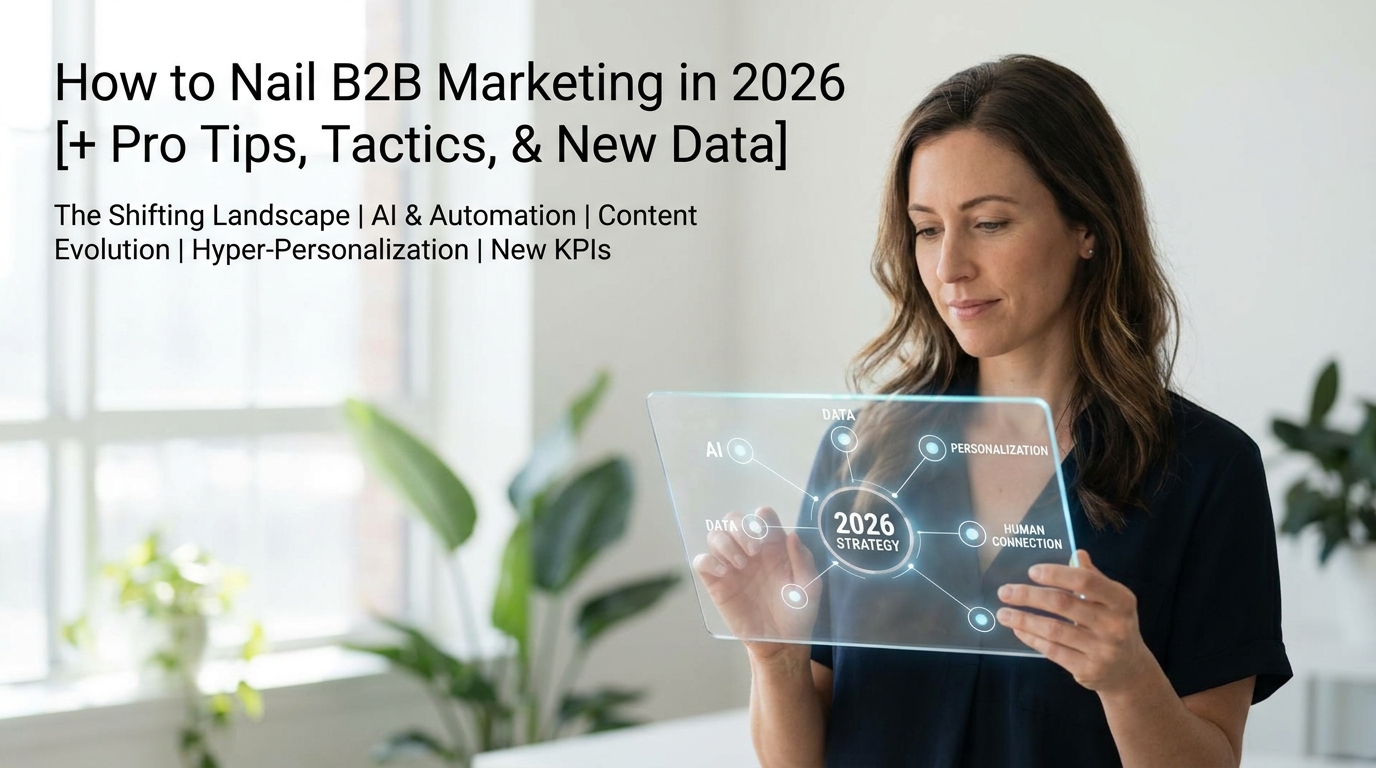
The world of B2B marketing is in a constant state of flux, but the pace of change we're witnessing as we approach 2026 is unprecedented. Gone are the days of sterile corporate messaging, generic email blasts, and a one-size-fits-all sales funnel. Today's B2B buyer, increasingly composed of digitally native millennials and Gen Z, expects more. They demand authenticity, personalization, and genuine value before they even consider a conversation with a sales rep. The strategies that worked in 2020, let alone 2010, are now relics of a bygone era. To succeed, businesses must pivot from being mere sellers to becoming trusted advisors and partners. This fundamental shift is being supercharged by advancements in artificial intelligence, a renewed focus on human-centric experiences, and a complete reimagining of the customer journey. This guide will serve as your comprehensive roadmap for navigating this new terrain. We'll dive deep into the essential trends, actionable tactics, and data-driven strategies you need to not just survive but thrive in the dynamic landscape of b2b marketing 2026. Get ready to transform your approach and build lasting, profitable relationships with your clients.
The Shifting Landscape: Key B2B Marketing Trends for 2026
To master b2b marketing 2026, you first need to understand the fundamental shifts in the environment. These aren't fleeting fads; they are deep, structural changes in how businesses buy and sell. The most successful marketers will be those who adapt to these new realities proactively.
First, the B2B buyer has changed. The C-suite is no longer dominated by one demographic. Millennials now hold a significant number of decision-making roles, with Gen Z rapidly entering the workforce and influencing purchasing committees. These buyers grew up with the internet, value peer reviews and social proof over a sales pitch, and are comfortable conducting the majority of their research independently and anonymously. They expect seamless, digital-first experiences, much like the ones they encounter in their B2C lives.
Second, trust is the new currency. In an age of information overload and AI-generated content, authenticity and transparency are paramount. Buyers are looking for partners, not just vendors. This means your brand’s reputation, its thought leadership, and its commitment to customer success are more critical than ever. Building a community around your brand and showcasing genuine customer stories will be far more effective thaninterruptive advertising.
Finally, the convergence of technology and human connection is a defining trend. While AI and automation are becoming indispensable for efficiency and scale, they must be used to enhance, not replace, the human element. The future lies in a "tech-and-touch" approach, where technology handles the repetitive tasks and data analysis, freeing up human marketers to focus on strategy, creativity, and building genuine relationships. Businesses that find this balance will create a powerful competitive advantage.
AI and Automation: Your New B2B Marketing Superpowers
Artificial intelligence is no longer a futuristic concept; it's a foundational pillar of modern B2B marketing. By 2026, organizations that haven't integrated AI into their marketing stack will be at a severe disadvantage. It's about working smarter, not just harder, and using data to make decisions that were previously based on gut feelings.
Here’s how AI is reshaping the game:
- Predictive Analytics and Lead Scoring: AI algorithms can analyze vast datasets of historical customer behavior, firmographics, and engagement signals to predict which leads are most likely to convert. This allows sales and marketing teams to focus their resources on high-potential accounts, dramatically improving efficiency and shortening sales cycles. Instead of a simple point system, AI models can identify complex patterns that indicate purchase intent.
- Generative AI for Content Ideation and Creation: Generative AI tools can be incredible assistants for brainstorming blog topics, drafting social media posts, and even creating initial outlines for whitepapers. The key in 2026 is not to let AI replace your writers but to augment their creativity. Use AI for research and first drafts, but ensure a human expert refines, fact-checks, and injects your unique brand voice and perspective. This human oversight is crucial for maintaining authenticity and thought leadership.
- AI-Powered Personalization at Scale: As we'll discuss further, personalization is critical. AI makes it possible to deliver highly individualized experiences to thousands of prospects simultaneously. This can range from dynamically changing website content based on a visitor's industry to personalizing email nurture sequences based on the content they've consumed.
- Intelligent Automation Workflows: Modern automation goes beyond simple "if-then" rules. AI can trigger complex, multi-channel workflows based on a prospect's behavior score or predictive model. For example, if an account's engagement score crosses a certain threshold, it could automatically trigger a personalized email from the assigned account executive and a targeted ad campaign on LinkedIn.
The Unwavering Power of Content: Evolving for a Savvy Audience
Content remains the heart of B2B marketing, but the type of content that resonates has evolved significantly. The self-serving, product-centric content of the past is dead. In 2026, your content strategy must be built on a foundation of providing genuine, tangible value to your audience. The goal is to become an indispensable resource and a trusted thought leader in your industry.
Your new content playbook should include:
- A Focus on "Problem-Aware" and "Solution-Aware" Content: Don't just talk about your product. Create content that helps your audience better understand their own problems. Then, create content that educates them on the various types of solutions available (including, but not limited to, yours). This builds trust long before a sales conversation begins. Think in-depth guides, original research reports, and framework-based articles.
- The Rise of Interactive and Experiential Content: Passive consumption is out. Engage your audience with interactive content like ROI calculators, assessment tools, quizzes, and configurators. This type of content not only provides immediate value to the user but also gives you valuable data about their needs and challenges.
- A Multi-Format Video Strategy: Video is non-negotiable. Your b2b marketing 2026 strategy needs a mix of formats. Use short-form video (like YouTube Shorts or LinkedIn videos) for capturing attention and building brand awareness. Use long-form video, such as detailed webinars, product deep-dives, and customer case study interviews, for mid-funnel education and nurturing. Live-streamed Q&A sessions with your experts can be incredibly effective for building community and trust.
- Podcasting as a Relationship-Builder: B2B podcasts continue to be a powerful medium for building an intimate connection with your audience. Interviewing industry experts, customers, and internal thought leaders allows you to have nuanced conversations and establish your brand as a central voice in your niche.
Re-engineering the B2B Sales Funnel for 2026
The traditional, linear B2B sales funnel (Awareness > Interest > Consideration > Purchase) is an outdated model that no longer reflects reality. The modern B2B buyer's journey is a complex, multi-touchpoint, and often unpredictable web. They jump between channels, consume content in their own time, and involve a committee of stakeholders. To succeed, you must ditch the funnel and embrace a customer-centric flywheel model.
In the flywheel model, the focus is on using the momentum of your happy customers to drive referrals and repeat business. The stages are Attract, Engage, and Delight. The key is to reduce friction at every stage to keep the wheel spinning.
Key tactics for this new model include:
- Account-Based Marketing (ABM) 2.0: ABM is more important than ever. Instead of casting a wide net, focus your marketing and sales efforts on a curated list of best-fit target accounts. Use data and AI to identify these accounts and then orchestrate highly personalized, multi-channel campaigns that speak directly to their specific pain points. The "Engage" phase of the flywheel is where ABM shines.
- Omnichannel Consistency: Your prospects don't see channels; they see one brand. Your messaging, branding, and user experience must be seamless whether they're on your website, reading a LinkedIn post, watching a YouTube video, or talking to a chatbot. Data must be unified across these platforms to ensure a consistent and personalized journey.
- Sales and Marketing Alignment (Smarketing): This is a perennial goal, but in 2026, it's a requirement for survival. Sales and marketing must operate from a single source of truth regarding data, share the same revenue goals, and have a clear service-level agreement (SLA) on lead handoffs and follow-ups. A frictionless flywheel is impossible when these two teams are misaligned.
Hyper-Personalization: Moving Beyond {First_Name}
For years, marketers have touted personalization, but often it meant little more than inserting a prospect's first name into an email template. The expectations for b2b marketing 2026 are exponentially higher. We're now in the era of hyper-personalization, which means tailoring the entire customer experience to an individual's or an account's specific context, behavior, and needs.
This requires a sophisticated approach to data and technology. It's about showing your prospect that you've done your homework and genuinely understand their world.
Actionable hyper-personalization tactics include:
- Dynamic Website Content: With the right tools, your website can become a chameleon. A visitor from the healthcare industry could see case studies, imagery, and headline copy relevant to hospitals, while a visitor from the financial services sector sees content tailored to banks. This is achieved by analyzing data points like IP address, firmographic data from third-party services, or past browsing behavior.
- Behavior-Triggered Nurturing: Move beyond generic drip campaigns. Create email and ad sequences that are triggered by specific actions. For example, if a prospect downloads a whitepaper on "AI in Logistics," they should enter a nurture stream that provides more content on that specific topic, not a generic company newsletter.
- Personalized Sales Collateral: Equip your sales team with tools that allow them to create customized sales decks, proposals, and landing pages for their key accounts in minutes. These materials can dynamically pull in the prospect's logo, reference their specific industry challenges, and highlight the product features most relevant to them based on their engagement data.
- Contextual Chatbots and Live Chat: Instead of a generic "How can I help you?" greeting, AI-powered chatbots can access CRM data to greet a known visitor by name, reference their recent website activity ("I see you were just looking at our enterprise pricing page..."), and route them to the correct specialist instantly.
New Data and KPIs: Measuring What Truly Matters
The way we measure marketing success must evolve alongside our strategies. Vanity metrics like raw lead counts or impressions are becoming less and less meaningful. In the complex world of b2b marketing 2026, you need to focus on KPIs that directly reflect business impact and the health of your customer relationships.
Shift your focus to these crucial metrics:
- Customer Lifetime Value (CLV): This is perhaps the most important metric. It tells you the total revenue a business can expect from a single customer account. Marketing's goal should be to attract customers with high CLV potential and to implement programs that increase the CLV of existing customers.
- Pipeline Velocity: This measures how quickly deals are moving through your sales pipeline from creation to close. A faster velocity means a more efficient sales and marketing engine. Marketing can directly impact this by providing better-qualified leads and creating mid-funnel content that accelerates the buying decision.
- Customer Acquisition Cost (CAC) and CAC Payback Period: You need to know exactly how much it costs to acquire a new customer and how long it takes for that customer to become profitable. This helps you make smart decisions about where to invest your marketing budget.
- Marketing-Sourced and Marketing-Influenced Revenue: Move beyond MQLs (Marketing Qualified Leads). The ultimate measure of success is revenue. Use sophisticated attribution models (like multi-touch attribution) to understand how marketing activities are sourcing new deals and influencing existing opportunities in the pipeline.
- Account Engagement Score: For ABM strategies, track a blended engagement score for each target account. This score aggregates signals across all contacts within the account—website visits, content downloads, email opens, ad clicks, event attendance—to give you a holistic view of an account's interest level and purchase readiness.
As we look toward the horizon of b2b marketing 2026, the path to success is clear, albeit challenging. It's a path paved with a powerful synergy of human ingenuity and artificial intelligence. It's about dismantling the old, rigid sales funnel and embracing a fluid, customer-centric flywheel model where delighting customers creates a self-sustaining cycle of growth and advocacy. The key takeaway is the shift from broadcasting to connecting. Your content must educate and empower, not just sell. Your personalization efforts must go beyond surface-level tokens to create genuinely bespoke experiences that show you understand your client's unique challenges. The data you track must evolve to measure what truly matters: long-term value, relationship strength, and pipeline velocity. The future of B2B marketing isn't about finding the one magic bullet; it's about building a sophisticated, agile, and deeply human marketing engine. By embracing the trends and tactics outlined here—from leveraging AI for predictive insights to focusing on authentic thought leadership—you can position your brand as an indispensable partner, build unshakeable trust, and ultimately, nail your marketing strategy for 2026 and beyond.


