
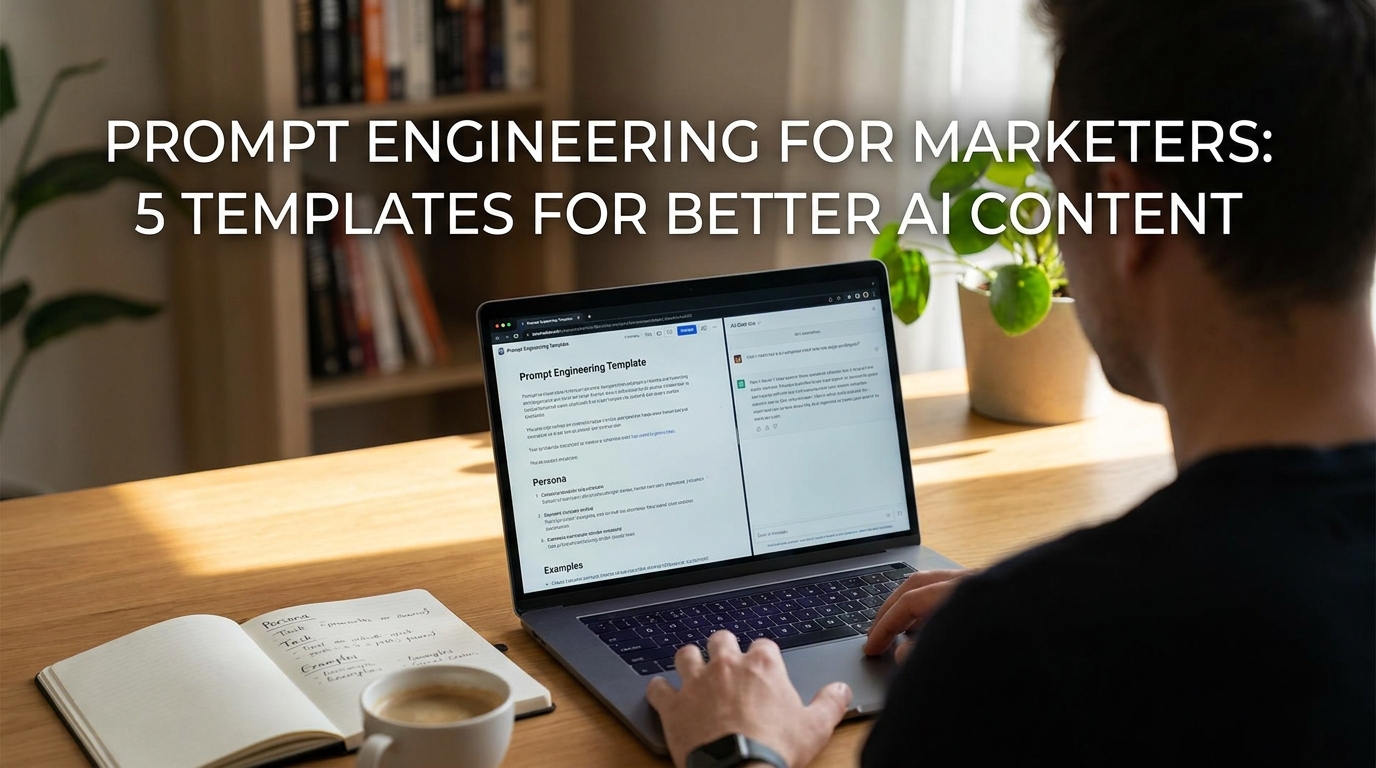
The rise of artificial intelligence has irrevocably changed the landscape of digital marketing. Tools like ChatGPT, Claude, and Gemini are no longer novelties; they are essential components of the modern marketer's toolkit. From drafting emails to brainstorming campaign ideas, AI promises unprecedented efficiency. However, many marketers are discovering a frustrating reality: the content generated by AI can often be generic, soulless, and misaligned with their brand's unique identity. It lacks the nuance, strategy, and persuasive power needed to truly connect with an audience and drive results. The problem isn't the AI itself, but how we communicate with it. The key to unlocking its true potential lies in a skill that is rapidly becoming indispensable: prompt engineering.
Prompt engineering is the art and science of crafting precise, context-rich instructions to guide AI models toward a desired outcome. It's the difference between asking a junior assistant to "write a blog post" and providing a detailed creative brief with a target audience, key messaging, tone of voice, and specific examples. For marketers, mastering this skill means transforming a generic content generator into a highly specialized, on-brand creative partner. In this article, we'll move beyond simple commands and dive into the world of advanced prompt engineering. We will explore five powerful, copy-and-paste templates designed specifically for marketing tasks, including how to capture your brand's voice, create GEO-optimized article outlines, and even generate technical SEO elements like FAQ schema. Get ready to elevate your AI-powered content from mediocre to magnetic.
What is Prompt Engineering and Why Should Marketers Care?
At its core, prompt engineering is simply the practice of designing inputs for AI models that will produce optimal outputs. Think of it as learning the language of your AI assistant. A basic, one-sentence command is like speaking in broken phrases; you might be understood, but the response will likely be simplistic. A well-engineered prompt, on the other hand, is like having a detailed, strategic conversation. It provides the AI with the necessary context, constraints, and goals to perform a task with skill and precision.
For marketers, the "why" is tied directly to performance and ROI. The internet is already saturated with generic, AI-generated content. To stand out, your content must have a distinct personality, provide genuine value, and be strategically optimized for search engines. This is where prompt engineering becomes a superpower.
- Brand Consistency: Without proper guidance, an AI has no concept of your brand's unique voice, values, or style. Prompt engineering ensures every piece of content, from a tweet to a whitepaper, sounds authentically like you.
- Strategic SEO: You can instruct an AI to think like an SEO specialist, incorporating specific keywords, structuring content for featured snippets, and even targeting local search intent.
- Improved Efficiency: While AI is fast, a poor prompt leads to a cycle of endless revisions. A great initial prompt saves significant time by getting you 90% of the way to a finished product on the first try.
- Enhanced Creativity: By setting clear creative boundaries and providing inspirational examples, you can use AI not just for grunt work, but as a powerful brainstorming partner that can generate novel ideas within your strategic framework.
Ultimately, prompt engineering is the bridge between the raw power of AI and the strategic goals of marketing. It's the human touch that ensures the technology serves the strategy, not the other way around.
The Core Principles of Effective Prompting
Before we dive into the specific templates, it's crucial to understand the foundational principles that make them work. Mastering these concepts will allow you to not only use our templates effectively but also to adapt and create your own for any marketing task imaginable.
1. Assign a Persona and Provide Rich Context
Never let the AI guess who it's supposed to be. Start your prompt by assigning a role. Instead of just asking for content, tell the AI to "Act as an expert B2B SaaS content marketer with 10 years of experience" or "You are a witty social media manager for a direct-to-consumer fashion brand." This immediately frames the AI's knowledge and stylistic choices. Following the persona, provide context. Who is the target audience? What are their pain points? What is the ultimate goal of this piece of content (e.g., drive free trial sign-ups, educate the user, build brand affinity)?
2. Be Hyper-Specific with Your Instructions
Vague prompts lead to vague results. The more detailed your instructions, the better the output. Don't just say "write a blog post." Instead, specify the word count, the target reading level, the exact sections you want included (e.g., Introduction, Section 1 Title, Section 2 Title, Conclusion), and any specific points or data you want to be mentioned. If you want a list, specify if it should be bulleted or numbered.
3. Use Examples (Few-Shot Prompting)
This is one of the most powerful techniques. AI models learn from patterns. By providing a few examples of what you're looking for, you give the model a concrete pattern to follow. This is especially useful for tone of voice. You can include a short paragraph from your existing website copy and say, "Write in a tone similar to this example." This is called "few-shot prompting" and it dramatically improves the quality and consistency of the output.
4. Iterate and Refine
Don't expect the perfect result on the very first try. The best prompts are often the result of a conversational process. Use the first output as a starting point. Identify what you like and what you don't, then refine your prompt with more specific instructions. For example, you might follow up with, "That's a good start, but can you make the tone more conversational and add a section about [specific topic]?" This iterative loop is where the real magic happens.
Template 1: Mastering Your Brand Voice
One of the biggest challenges for marketers using AI is maintaining a consistent and recognizable brand voice. AI tends to default to a helpful but bland and corporate tone. This template forces the AI to adopt your specific personality, ensuring every piece of content feels like it came from your team.
The Challenge: You need to create a blog post that's not only informative but also embodies your brand's unique blend of wit, authority, and empathy. A simple prompt will result in a generic article that could have been written by anyone.
The Prompt Template:
### PERSONA ###

Act as our lead content strategist. You have a deep understanding of our brand and our audience.
### BRAND VOICE & TONE GUIDELINES ###
Our brand voice is:
- Expert, but not arrogant: We use clear, confident language. We back up claims with data or examples but avoid overly academic or complex jargon.
- Witty and clever: We appreciate a good pun or a clever metaphor. We are not afraid to be playful, but the humor should always be smart.
- Empathetic and encouraging: We understand our audience's struggles and we are their biggest cheerleaders. Our tone should be supportive.
- Things to avoid: Do not use corporate buzzwords like "synergy," "leverage," or "paradigm shift." Avoid overly enthusiastic exclamation points. Keep sentences and paragraphs relatively short for readability.
### AUDIENCE ###
Our target audience is freelance graphic designers with 2-5 years of experience. They are struggling with the business side of their work, such as finding clients, pricing their services, and managing projects. They feel creatively fulfilled but financially stressed.
### EXAMPLE OF OUR VOICE ###
"Tired of the feast-or-famine client cycle? We get it. One month you're drowning in briefs, the next you're refreshing your inbox like it's a slot machine. Let's build a better system, one that doesn't run on caffeine and panic."
### TASK ###
Write a 1,200-word blog post titled "5 Pricing Strategies to Stop Underselling Your Design Work." The post should include an introduction that hooks the reader with an empathetic pain point, five distinct sections for each strategy with actionable advice, and a concluding section that encourages them to take action.
Why it Works: This prompt leaves no room for interpretation. The AI is given a role (Persona), a detailed style guide (Voice & Tone), a clear picture of the reader (Audience), a concrete example of the desired output (Example), and a specific, structured task (Task). This multi-layered approach is the key to generating content that truly feels on-brand.
Template 2: Building a GEO-Optimized Article Outline
For businesses that rely on local customers, ranking for geographic search queries is essential. Creating content that effectively targets a specific city, state, or neighborhood requires more than just sprinkling in location names. This template instructs the AI to think like a local SEO expert and build a strategic content foundation.
The Challenge: A new coffee shop in Austin, Texas, wants to create a blog post to attract local customers searching for "best coffee shops in Austin." A generic outline won't capture the local flavor or the specific search terms people use.
The Prompt Template:
### PERSONA ###

You are an expert SEO strategist specializing in local SEO for the food and beverage industry.
### GOAL ###
Create a comprehensive, SEO-optimized blog post outline for an article titled "The Ultimate Guide to the Best Coffee Shops in Austin, Texas." The goal is to rank for the primary keyword and related local search queries.
### PRIMARY KEYWORD ###
"best coffee shops in Austin"
### TARGET AUDIENCE ###
Local Austin residents, remote workers, and tourists looking for high-quality coffee experiences. They value atmosphere, coffee quality, and unique offerings.
### GEOGRAPHIC FOCUS ###
Austin, Texas. The outline should encourage mentioning specific, popular neighborhoods like South Congress (SoCo), East Austin, and the Domain.
### OUTLINE REQUIREMENTS ###
The outline must include the following structure:
- An H1 Title.
- An Introduction that hooks the reader and mentions the primary keyword.
- At least 5 H2 sections, each focusing on a different category (e.g., "Best for Remote Work," "Best for Artisanal Espresso," "Best for Outdoor Patios").
- Under each H2, include 2-3 H3s, each representing a specific coffee shop. For each H3, suggest what to mention (e.g., signature drink, Wi-Fi speed, vibe).
- A section on "What Makes Austin's Coffee Scene Special?".
- A concluding section.
- Suggest 3-5 relevant LSI (Latent Semantic Indexing) keywords and long-tail variations to naturally incorporate throughout the article (e.g., "austin coffee shops with wifi," "east austin cafe," "south congress coffee").
- Suggest an idea for an internal link to another page on our website (e.g., our menu page).
Why it Works: This prompt transforms the AI from a simple writer into a content strategist. By specifying the primary keyword, geographic focus, and required structure (H1, H2s, H3s), you ensure the output is designed for search engine crawlers as well as human readers. The inclusion of LSI keywords and internal linking suggestions adds another layer of SEO value, providing a ready-to-use blueprint for a high-ranking article.
Template 3: Generating FAQ Schema From Existing Content
FAQ schema is a type of structured data that you can add to your website's code to help search engines understand your content. When implemented correctly, it can result in a rich snippet in the search results, making your listing larger and more clickable. Manually identifying questions and writing answers is time-consuming. This template automates the process.
The Challenge: You've just published a detailed blog post and want to maximize its SEO potential by adding FAQ schema, but you don't have time to sift through the text and write the questions and answers yourself.
The Prompt Template:
### PERSONA ###

You are a technical SEO specialist with expertise in creating structured data markup. Your task is to extract information and format it correctly for an FAQPage schema.
### TASK ###
Analyze the complete blog post text provided below and generate a list of 4 relevant question-and-answer pairs that would be suitable for an FAQPage schema.
### RULES & CONSTRAINTS ###
1. The questions should be phrased as a user would ask them.
2. The answers must be directly derived from the provided text. Do not invent new information.
3. The answers should be concise, ideally 1-3 sentences long.
4. The content should be non-promotional and directly answer the question.
5. Format the output clearly with each question followed by its corresponding answer.
### SOURCE CONTENT ###
[Paste the entire text of your published blog post here]
Why it Works: This is a highly efficient, task-oriented prompt. It assigns a very specific, technical persona. The rules and constraints are critical here—they prevent the AI from getting too creative or writing long, unhelpful answers. By instructing it to only use the source content, you ensure accuracy and relevance. This prompt can save a marketer 15-30 minutes per blog post, which adds up significantly over time, all while improving search visibility.
Two More Advanced Templates for Your Marketing Toolkit
To round out your prompt engineering arsenal, here are two more templates that tackle common, high-value marketing tasks: writing conversion-focused copy and efficiently repurposing content for social media.
Template 4: The AIDA Copywriting Framework Prompt
The AIDA (Attention, Interest, Desire, Action) model is a time-tested copywriting framework for creating persuasive copy. This prompt guides the AI to use this proven structure for landing pages, ads, or email copy.
### PERSONA ###

Act as an expert direct-response copywriter with a track record of writing high-converting sales pages.
### FRAMEWORK ###
You must use the AIDA (Attention, Interest, Desire, Action) framework for this task.
### PRODUCT DETAILS ###
Product Name: "FocusFlow," a project management app for freelancers.
Key Features: AI-powered task scheduling, automated client invoicing, time tracking.
Key Benefits: Saves users an average of 10 hours per week on admin, helps them get paid faster, reduces the stress of juggling multiple projects.
### AUDIENCE PAIN POINTS ###
The target audience struggles with disorganization, forgets to bill for all their time, and feels overwhelmed by administrative tasks, which takes time away from their creative work.
### TASK ###
Write the copy for a landing page for the "FocusFlow" app. Structure the output clearly into four sections: Attention, Interest, Desire, and Action. The call to action is to "Start Your 14-Day Free Trial."
Template 5: The Social Media Content Repurposing Prompt
Creating unique content for every social media platform is a massive drain on resources. This prompt turns a single long-form piece of content into a week's worth of platform-specific social posts.
### PERSONA ###

You are a savvy social media manager for a B2B technology blog. You excel at adapting content to fit the unique audience and format of each platform.
### GOAL ###
Repurpose the key ideas from the source article provided below into a series of engaging social media posts.
### PLATFORM-SPECIFIC INSTRUCTIONS ###
- LinkedIn (2 Posts): Write two thought-leadership style posts. Each should present a key argument from the article, ask a thought-provoking question to encourage comments, and use 3-5 professional hashtags (e.g., #ProjectManagement, #Productivity, #FutureOfWork).
- Twitter/X (4 Tweets): Generate four short, punchy tweets. One should be a surprising statistic from the article. One should be a direct, impactful quote. Two should be a key takeaway. All should include a link to the article and 2-3 relevant hashtags.
- Instagram (1 Post Idea): Write an engaging caption for an Instagram carousel post. The caption should summarize the 3 main tips from the article. Also, suggest the content for each of the 3 carousel slides (e.g., Slide 1: Title and hook; Slide 2: Tip 1 with an icon; Slide 3: Tip 2 with an icon...).
### SOURCE ARTICLE ###
[Paste the text of your blog post or article here]
Conclusion: You Are the Strategist, AI is Your Tool
We've journeyed through the core principles of prompt engineering and explored five powerful, practical templates that you can implement today. From capturing your unique brand voice and structuring GEO-optimized outlines to generating technical SEO elements and repurposing content at scale, it's clear that the quality of your AI-generated content is directly proportional to the quality of your prompts. These templates are not rigid formulas but starting points. The real power comes when you begin to adapt, combine, and create your own prompts tailored to your specific marketing challenges. See them as a framework for thinking, a new way to communicate your strategic vision to your AI partner.
Remember, the goal of using AI in marketing is not to replace human creativity but to augment it. Prompt engineering is the skill that ensures the human remains the strategist. You are the conductor of the orchestra, and the AI is your most versatile instrument. By mastering the art of the prompt, you move from being a passive user of a tool to an active director of a powerful creative force. Start with these templates, observe the outputs, and refine your approach. The more you practice, the more you will find that AI can help you create content that is not only more efficient to produce but also more effective, more strategic, and more authentically human.
More Tips For Website Improvement
2026
24Aug
How to Write a Marketing Plan, A Guide with Examples
Trying to grow a business without a marketing plan is like trying to navigate a vast, unknown ocean without a map, compass, or destination in mind. You might drift for a while, you might even find a small island by chance, but you're far more likely to get lost, run…

2026
15May
What is UTF-8 Encoding? A Guide for Content and SEO
Have you ever visited a website and seen a strange black diamond with a question mark inside (�)? Or perhaps you’ve seen text that looks like a jumble of random symbols, like "olé" instead of "olé"? This digital gibberish, often called "mojibake," is a…


