
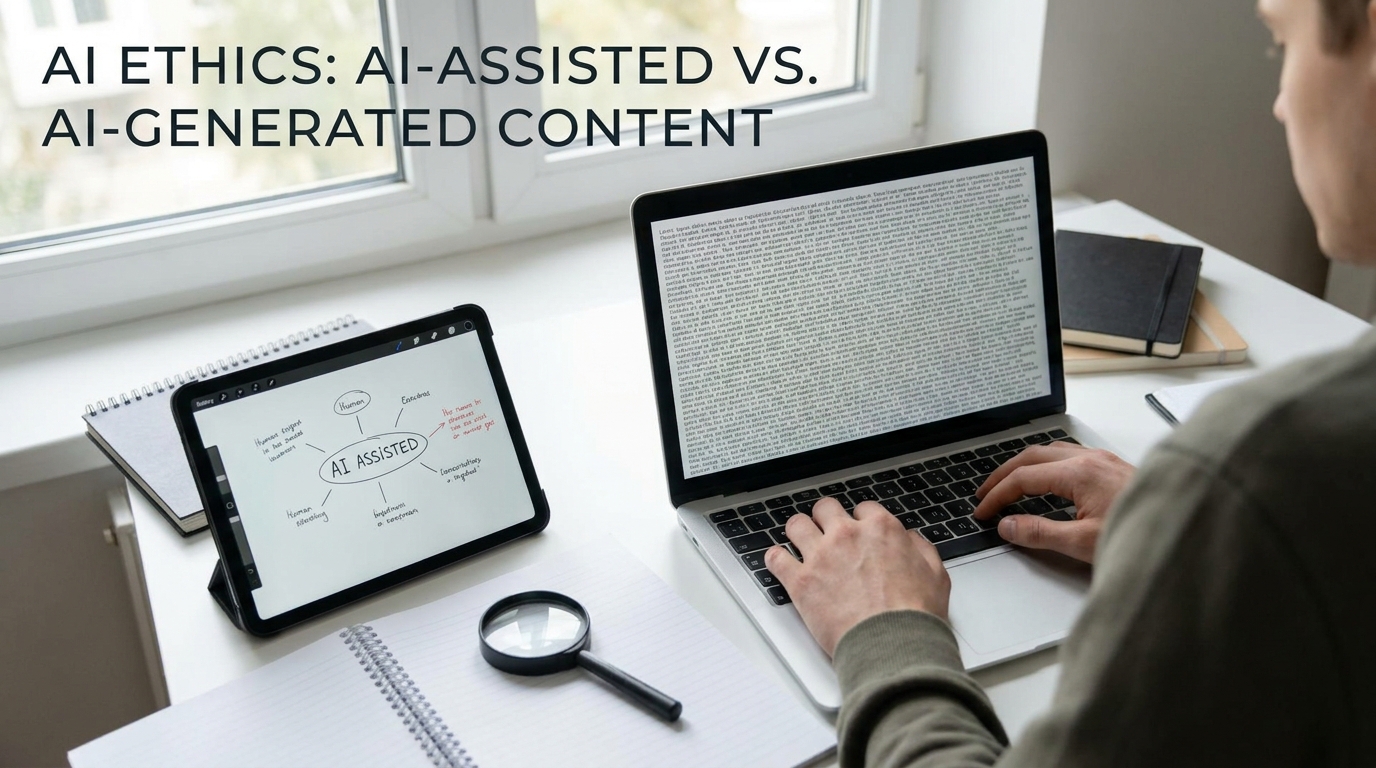
The digital content landscape is in the midst of a seismic shift. Generative artificial intelligence, once a concept confined to science fiction, has burst into the mainstream, offering powerful tools that can draft articles, write code, and create images in seconds. For content creators, marketers, and businesses, this technology presents a tantalizing promise: the ability to produce more content, faster than ever before. But as we race to embrace this new efficiency, a critical conversation is being left in the dust—the conversation about ethics. The rise of AI in content creation has drawn a new, blurry line in the sand, separating two fundamentally different approaches: "AI-assisted" and "AI-generated." Understanding this distinction is not just a matter of semantics; it's the core of a debate about authenticity, responsibility, and the very future of trustworthy information on the internet. This article will dive deep into this ethical crossroads. We will unpack the nuanced differences between using AI as a tool and using it as a replacement for human creativity. We will explore Google's official stance on AI content and how its core principles of quality and trustworthiness apply. Ultimately, we will argue that the most ethical, sustainable, and effective path forward lies not in outsourcing our thinking to machines, but in forging a powerful partnership where human expertise, verification, and voice remain firmly in the driver's seat.
The AI Content Revolution: A Double-Edged Sword
It’s impossible to ignore the explosion of AI writing tools. Platforms like OpenAI's ChatGPT, Google's Gemini, Jasper, and Copy.ai have become household names in digital marketing and content circles. Their capabilities are undeniably impressive. They can generate a blog post outline from a single keyword, draft social media captions in multiple tones, summarize dense research papers, and even write complex code. For a busy content creator, this feels like a superpower. The potential benefits are clear and compelling:
- Unprecedented Speed and Scale: The most obvious advantage is the ability to scale content production dramatically. What once took a human writer hours or days can now be drafted by an AI in minutes. This allows teams to populate blogs, update websites, and fuel social media channels at a dizzying pace.
- Overcoming Creative Blocks: Every writer has stared at a blank page, willing the words to come. AI can serve as a fantastic brainstorming partner, offering different angles, headline ideas, or starter paragraphs to kickstart the creative process.
- Democratizing Creation: For small business owners or non-native English speakers, AI tools can help level the playing field, allowing them to produce professional-sounding copy for their websites and marketing materials without hiring expensive agencies.
However, this gleaming sword of efficiency has a perilous other edge. The same technology that promises to enhance creativity also holds the potential to dilute it, spread misinformation, and ultimately erode the trust between creators and their audiences. The dark side of the AI content revolution includes the mass production of generic, soulless articles designed purely to game search engine algorithms. We risk a future where the internet is flooded with low-quality, derivative content that lacks a human perspective, genuine experience, or critical thought. Even more dangerously, without rigorous human oversight, these tools can confidently present false information as fact, perpetuate hidden biases from their training data, and create content that is subtly plagiarized from existing sources. The promise of efficiency is real, but the price of unchecked automation could be the very integrity of the information ecosystem we rely on.
Defining the Terms: "AI-Generated" vs. "AI-Assisted"
At the heart of the ethical debate is the crucial distinction between "AI-generated" and "AI-assisted." While they may sound similar, they represent two vastly different philosophies of content creation. Confusing the two can lead to poor quality, ethical missteps, and penalties from search engines. Let's break down exactly what each term means.
What is "AI-Generated" Content?
"AI-generated" content is material where the artificial intelligence does the vast majority of the heavy lifting. In this workflow, the human's role is often reduced to that of a prompter or a machine operator. They provide an initial topic, a few keywords, and perhaps a desired tone of voice. The AI then takes over, structuring the article, forming the arguments, writing the paragraphs, and delivering a nearly-finished draft. The human input after this point is minimal—perhaps a quick grammar check or a light edit.
This approach prioritizes volume and speed above all else. The goal is to churn out content as quickly as possible. However, this method is fraught with risks:
- Factual Inaccuracies: AI models are known to "hallucinate," which means they can invent facts, statistics, and sources with absolute confidence. A purely AI-generated article on a medical topic, for example, could contain dangerously incorrect advice.
- Lack of Originality and Depth: AI models are trained on existing internet data. They are masters of synthesizing and rephrasing what has already been said, but they cannot generate truly novel ideas, conduct original research, or offer unique insights based on lived experience.
- Generic, Soulless Prose: The content often lacks a distinct voice, personality, or emotional connection. It reads like a textbook summary rather than a compelling piece written by a passionate human.
What is "AI-Assisted" Content?
"AI-assisted" content, on the other hand, keeps the human creator at the center of the process. The human is the author, the strategist, and the final arbiter of quality. The AI is simply a powerful tool in their toolkit, much like a grammar checker, a thesaurus, or a research database.
In this model, the creator leverages AI for specific, targeted tasks to enhance their own work. Examples of an AI-assisted workflow include:
- Ideation: Using AI to brainstorm a list of potential blog post titles or subtopics for an article you are planning to write.
- Outlining: Asking an AI to generate a logical structure or outline for your ideas, which you then refine, reorder, and flesh out with your own expertise.
- Research Aid: Using AI to summarize long articles or find data points, which you then independently verify from primary sources.
- Rephrasing and Polishing: Highlighting a sentence you've written and asking the AI to suggest alternative phrasings for better clarity or flow.
In this partnership, the human provides the critical thinking, the domain expertise, the personal anecdotes, and the ethical judgment. The AI handles rote tasks, freeing up the human to focus on what they do best: creating high-quality, authentic, and valuable content.
Google's Tightrope Walk: E-E-A-T and the Stance on AI Content
Whenever a new content creation technique emerges, the million-dollar question for marketers and publishers is: "What does Google think?" Google's stance on AI content has evolved, but its core message has remained consistent. Google does not penalize content simply because it was made with the help of AI. Instead, its focus remains squarely on the quality and helpfulness of the content itself, regardless of its origin.
In its official documentation, Google states that its long-standing policy is to reward high-quality content and fight against spam. Using automation, including AI, to generate content with the primary purpose of manipulating search rankings is a violation of their spam policies. However, using AI to help create helpful, people-first content is perfectly acceptable. The key lies in intent and quality. The guiding light for understanding what Google considers "high-quality" is its E-E-A-T framework.
Decoding E-E-A-T in the Age of AI
E-E-A-T is an acronym that stands for Experience, Expertise, Authoritativeness, and Trustworthiness. These are the qualities that Google's algorithms are designed to identify and reward. Let's see how purely AI-generated content stacks up against this framework:
- Experience: This is a newer addition to the framework, emphasizing content created by someone with real, first-hand, lived experience on the topic. An AI has never repaired a leaky faucet, comforted a crying child, or hiked the Appalachian Trail. It can only simulate descriptions of these experiences by rehashing what others have written. Therefore, purely AI-generated content fundamentally fails the "Experience" test.
- Expertise: While an AI can access and regurgitate vast amounts of information on a subject, it doesn't possess true expertise. Expertise involves critical thinking, nuanced understanding, and the ability to make connections that aren't obvious in the training data. A human expert can provide this; an AI cannot.
- Authoritativeness: Authority is built over time through reputation, citations, and recognition by other experts in a field. An anonymous piece of AI-generated content has no inherent authority. Authoritativeness is tied to the author and the website, both of which are human constructs.
- Trustworthiness: This is the foundation of E-E-A-T. Trust is built on accuracy, transparency, and honesty. Because AI-generated content is prone to factual errors and lacks a verifiable author with real credentials, it struggles to establish trust with the reader.
When viewed through the E-E-A-T lens, it becomes clear that while AI can be a powerful assistant, relying on it solely to generate content is a losing strategy. The AI-assisted approach, where a human with real experience and expertise guides the process and verifies all information, is the only way to consistently create content that aligns with what Google—and more importantly, human readers—are looking for.
The Ethical Minefield of Purely AI-Generated Content
Beyond search engine rankings, the move toward purely AI-generated content opens a Pandora's box of complex ethical issues that strike at the heart of digital communication. These aren't just theoretical problems; they have real-world consequences for creators, consumers, and society as a whole.
Deception and the Erosion of Authenticity
One of the primary ethical concerns is deception. When a website publishes an article written entirely by a machine but presents it as if it were written by a human, it is being dishonest with its audience. This breaks an implicit contract of trust. Readers visit blogs and websites to connect with a human perspective, to learn from someone's unique experiences and insights. The AI-generated article, devoid of genuine thought or feeling, is a counterfeit of that experience. Over time, this practice can lead to a widespread erosion of authenticity online, where users become increasingly skeptical of everything they read, unsure if they're interacting with a real person or a clever algorithm.
The Amplification of Misinformation and Bias
AI language models are not arbiters of truth. They are complex pattern-matching systems trained on a snapshot of the internet—a source rife with inaccuracies, conspiracy theories, and systemic biases. Without a knowledgeable human to guide and correct them, these models can inadvertently generate and amplify misinformation on a massive scale. They can present outdated medical advice, incorrect historical facts, or biased social commentary as objective truth. Furthermore, because the training data reflects existing societal biases related to race, gender, and culture, the AI's output can perpetuate and even strengthen harmful stereotypes, all under a veneer of machine-made neutrality.
Intellectual Property and Plagiarism Puzzles
The issue of ownership and originality is another thorny area. Who owns the copyright to a piece of text generated by an AI? Is it the user who wrote the prompt, the company that developed the AI, or does it belong to the public domain? The legal frameworks are still catching up. More pressingly, how does an AI "learn" to write? It does so by analyzing billions of examples of human-written text. While it doesn't typically copy-paste directly, its output is a sophisticated remix of its training data. This creates a blurry line between "synthesis" and "unintentional plagiarism," where the AI might generate passages that are substantially similar to its source material without proper attribution, putting the publisher at legal risk.
Devaluing Human Skill and Creativity
Finally, there's the long-term cultural impact. What happens to the craft of writing, research, and critical thinking in a world where content can be conjured instantly at no cost? An over-reliance on AI-generated content devalues the skill, effort, and expertise of human writers, journalists, and creators. It risks turning content creation from a thoughtful process of inquiry and expression into a commoditized, automated task. This not only affects the livelihoods of creative professionals but also diminishes the quality and diversity of the information we all consume, leading to a more homogenous and less thoughtful digital world.
The Power of the Human-AI Partnership: The "AI-Assisted" Advantage
The solution to the ethical and practical problems of AI-generated content is not to reject the technology entirely. That would be like a carpenter refusing to use a power saw. The future lies in embracing the "AI-assisted" model—a powerful synergy where human intelligence is augmented, not replaced, by artificial intelligence. This human-in-the-loop approach harnesses the best of both worlds, leading to content that is not only efficient to produce but also accurate, authentic, and truly valuable.
Enhancing, Not Replacing, Expertise
In the AI-assisted model, the human expert remains the captain of the ship. Imagine a financial analyst writing a market report. They can use an AI to quickly pull and summarize raw financial data from the past quarter. But it is the analyst's human expertise that allows them to interpret that data, identify the underlying trends, and provide insightful, forward-looking advice. The AI handles the grunt work of data collection, freeing up the human expert to focus on high-level analysis and strategic thinking. This same principle applies to any field. A historian can use AI to scan archives for mentions of a specific event, but it is the historian's critical judgment that weaves those mentions into a coherent and accurate narrative. AI becomes a research assistant that supercharges human intellect.
Upholding Quality and Accuracy as the Ultimate Goal
The single greatest weakness of AI is its unreliability. As mentioned, AI models can "hallucinate" and state falsehoods with unwavering confidence. The AI-assisted approach positions the human as the essential final checkpoint for quality and accuracy. Every fact, every statistic, every quote suggested by the AI must be rigorously fact-checked against reliable, primary sources by the human author. This non-negotiable step is what separates responsible content creation from the reckless spread of misinformation. The human's role as editor and verifier ensures that the final product is not just plausible but verifiably true, building the all-important E-E-A-T signal of Trustworthiness.
Injecting Nuance, Empathy, and a Unique Voice
Perhaps the most irreplaceable human contribution is the "soul" of the content. AI can mimic writing styles, but it cannot genuinely feel emotion, understand cultural nuance, or share a personal story with authentic vulnerability. It's the human author who can connect with the reader on an emotional level, using empathy and shared experience to make the content relatable and memorable. It's the human who develops a unique brand voice—be it witty, authoritative, compassionate, or inspiring—that builds a loyal audience over time. This human touch is what transforms a dry collection of facts into a compelling story that resonates with people and encourages them to take action. The AI can help build the car, but the human is the one who drives it with purpose and passion.
Practical Strategies for Ethical AI-Assisted Content Creation
Adopting an AI-assisted philosophy is about developing a new workflow that leverages AI's strengths while mitigating its weaknesses. It requires discipline, critical thinking, and a commitment to quality. Here are some practical, actionable strategies for integrating AI into your content creation process ethically and effectively.
1. Use AI for Ideation and Structuring
The blank page can be intimidating. Use AI as your creative springboard.
- Brainstorming: Feed the AI a core topic and ask for a list of related subtopics, common questions people ask, or interesting angles to explore. For example: "Give me 10 blog post ideas about sustainable gardening for beginners."
- Outlining: Once you have a topic, ask the AI to generate a potential outline. "Create a blog post outline for 'The Beginner's Guide to Drip Irrigation'." Do not accept this outline as final. Use it as a starting point. Reorder the sections, add your own unique points, and delete anything that is generic or irrelevant. You are the architect; the AI is just providing some initial scaffolding.
2. Employ AI as a Writing Partner, Not a Ghostwriter
Think of the AI as a co-pilot, not the pilot. It's there to help you navigate, not to fly the plane.
- Smashing Writer's Block: If you get stuck on a paragraph, paste what you have so far and ask the AI to "suggest a continuation" or "rephrase this for clarity." This can often provide the spark needed to get you writing again.
- Improving Your Own Writing: Write a draft yourself, then use AI to polish it. You can ask it to "make this paragraph more concise" or "suggest a stronger opening sentence for this section." You are still the author; the AI is your editor.
3. The Golden Rule: Verify Absolutely Everything
This is the most important ethical guideline. Treat any factual claim generated by an AI as unverified until you have proven it yourself from a reputable, primary source.
- Fact-Checking: If an AI states that "studies show X," do not take its word for it. Ask for the source of the study. If it provides one, go and find that study yourself. If it can't, assume the claim is false.
- Cross-Referencing: For any statistic, date, or specific piece of data, find at least two other reliable sources online that confirm the information before including it in your content.
4. Edit, Infuse, and Own the Final Product
The final and most crucial step is a thorough human edit. The piece of content should not go live until it reflects your voice, your expertise, and your standards.
- Add Your Experience: Weave in personal anecdotes, case studies, or unique insights that only you can provide. This is how you build E-E-A-T's "Experience" signal.
- Refine the Voice: Read the entire piece aloud. Does it sound like you? Does it match your brand's tone? Rewrite sentences to inject your personality and eliminate any generic, robotic-sounding phrasing.
- Final Quality Control: Check for flow, coherence, and logical consistency. The final article is your responsibility. Your name and reputation are attached to it, so make it something you are proud of.
5. Consider Transparency
While not always necessary for minor uses (like grammar checks), if AI played a significant role in the research or drafting process, consider adding a small disclosure. A simple line like, "This article was written by [Author Name] with the assistance of AI tools for research and outlining," can build trust with your audience by demonstrating honesty about your process.
Conclusion: A Call for Responsible Innovation
We are at a pivotal moment in the history of digital communication. The advent of powerful generative AI tools is not a passing trend; it is a fundamental shift in how we can create and disseminate information. The allure of instant, automated content is strong, promising unparalleled efficiency and scale. However, as we've explored, the path of purely "AI-generated" content is a perilous one, littered with ethical pitfalls ranging from the spread of misinformation and the erosion of audience trust to the devaluation of human creativity itself. It is a short-term shortcut that fails to align with the principles of quality, authenticity, and helpfulness that both users and search engines like Google demand, as encapsulated in the E-E-A-T framework.
The true promise of this technology lies not in replacing human creators, but in empowering them. The "AI-assisted" approach offers a responsible, sustainable, and far more powerful alternative. By positioning the human expert as the strategist, the verifier, and the final voice, we can harness AI's incredible processing power as a tool to augment our own intelligence. We can use it to overcome creative blocks, to streamline tedious research, and to polish our work, all while maintaining absolute control over the accuracy, integrity, and soul of our content. This human-AI partnership allows us to create better, more insightful, and more trustworthy content than ever before. It is a future where technology serves our expertise, rather than attempting to simulate it. As creators, marketers, and digital citizens, the choice is ours to make. Let's choose the path of responsible innovation—a path that champions human oversight and ensures that the digital world becomes a more, not less, reliable and authentic place.
More Tips For Website Improvement

2026
07Sep
GEO: How Generative AI is Reshaping Your Marketing Funnel
For decades, the marketing funnel has been a foundational concept, a reliable map guiding our efforts to turn strangers into customers. We meticulously crafted strategies for each stage—Awareness, Interest, Desire, Action—optimizing every touchpoint to gently…

2026
17Aug
Future-Proof Your Content Strategy for an AI World
The ground is shifting beneath our feet. For years, content marketing has operated on a familiar set of rules: find the right keywords, create high-quality content, build links, and repeat. But the rise of sophisticated artificial intelligence, from generative text…

2026
24Jul
AI Personalization and Privacy: Building Customer Trust
We stand at a remarkable technological crossroads. On one side, we have the dazzling promise of generative artificial intelligence, exemplified by powerful large language models like Google's Gemini. This technology offers a future of hyper-personalization, where…


